

Can My Child Skip a SwimSafer Stage?

By Coach Tan Meng Chew (MC), Founder and Head Coach, SG Sink Or Swim
It's a question I hear most often from parents of children who already swim reasonably well. Maybe your child picked up strokes at a holiday resort, learned from a relative, or spent years splashing around in a condo pool, and now you're wondering why they'd have to start at Stage 1 alongside a child who's never floated before. It's a completely reasonable thing to ask.
The short answer is that, as far as I can tell from how SwimSafer is structured, a child doesn't skip stages. What a strong swimmer can do is move through the early stages very quickly. In practice, that's a much smaller gap than most parents expect, and understanding the difference will save you a lot of frustration.
I'm Coach Tan Meng Chew, or MC, and I run SG Sink Or Swim. This guide explains why SwimSafer is built the way it is, what "fast-tracking" a capable swimmer actually looks like, and how to get your child placed at the right starting point.
The Direct Answer: Stages Are Sequential by Design
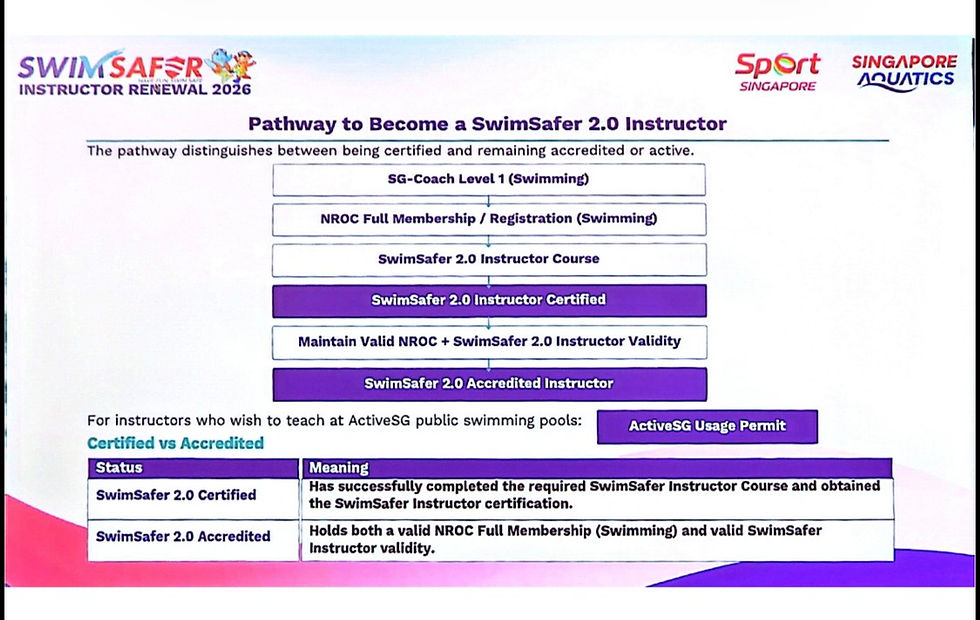
SwimSafer is structured as six progressive stages, each represented by a different cap colour and each building directly on the competencies of the stage before it. Stage 4 is Bronze, Stage 5 is Silver, and Stage 6 is Gold. The framework is designed so that a swimmer, whether child or adult, attempts each stage in sequence rather than jumping ahead, and my own understanding, consistent with the published guidance I've seen, is that stages aren't meant to be skipped.
Every stage has its own specific set of skills that a swimmer must demonstrate to pass, and each ends with both a practical in-water assessment and an online water-safety theory quiz with a 90% pass mark, certified nationally through the CAMS platform. That means each certificate represents a distinct, separately tested body of skills, not a general "level" that can be inferred from a higher one.
Why the System Works This Way
I think it helps to understand the reasoning, because it explains why "but my child can already do the harder stuff" doesn't automatically translate into permission to skip ahead.
Each stage genuinely builds on the last. The early stages cover water confidence, controlled floating and basic propulsion. Later stages layer on independent entries, continuous distance swims, stroke combinations, and eventually survival skills like treading water, clothed swimming, and basic rescue awareness. A skill demonstrated in Stage 5 assumes competence in the water-safety fundamentals tested in Stage 1 and 2, and the framework is built so that those fundamentals are actually checked rather than assumed.
Safety-relevant skills are spread across the stages, not concentrated at the top. A child might be a strong stroke swimmer while never having formally practised something like floating on their back to signal for help, or wearing a flotation aid, which appear in the early stages' survival skills components. Skipping those stages would mean skipping the skills that matter most if something goes wrong in the water, which is precisely the point of a water safety programme in the first place.
Assessments are independent and standardised. Since July 2025, assessors are assigned through CAMS specifically so that results are independent of any relationship with a particular coach or school. That consistency is the whole point of a national system, and it depends on each stage having a clear, defined set of criteria that a swimmer either meets or doesn't.
Higher stages involve real physical demands. Stage 6, Gold, for example, involves a compact jump entry into deep water, a head-first surface dive, extended underwater swimming, and distances reaching 100 metres. These are demanding skills, assessed in deep water, and the framework wants to be confident a swimmer has genuinely built up to that level rather than arrived there by a shortcut.
What "Fast-Tracking" Actually Looks Like
Here's the encouraging part, and the reason this question is less discouraging than it first sounds. While a stage can't be skipped, time spent on an early stage is not fixed.
The "roughly 12 hours per stage" figure is a guideline, not a minimum. SwimSafer stages are commonly described as taking roughly 12 hours of lesson time each, but that's an approximate expectation, not a mandatory requirement. A child who already has the underlying skills can be ready for an early-stage assessment after a fraction of that time, sometimes just a few sessions of targeted preparation.
A capable swimmer can move through early stages in quick succession. If your child already swims confidently, a good coach can assess them in the first lesson, identify exactly which stage's skills they already meet, and prepare them for that stage's assessment right away, rather than having them repeat drills they've already mastered. The gap between Stage 1 and Stage 3 might be a matter of weeks for a strong swimmer, rather than months.
Stage assessments are scheduled through CAMS, which sets its own pace. Registration slots open on CAMS weekly and up to three months in advance, with registration closing three weeks before the designated assessment day, and every registration must be validated by the recognised SwimSafer coach tagged to the participant. That means the practical speed at which a child can move through stages is partly governed by assessment availability, not just by their swimming ability, so even a very strong swimmer will typically need to work through a series of bookings over several months.
The real time saving is in the lessons, not the assessments. A strong swimmer doesn't need to spend 12 hours per stage in lessons preparing for material they already know. What they do still need, is to sit each stage's assessment and theory quiz in turn. Fast-tracking, in practice, means compressing the preparation time, not eliminating the assessments themselves.
What a Good Coach Does for a Child Who Already Swims Well
A proper assessment at the start. Rather than assuming a starting point from age or from what a parent reports, a good coach spends the first lesson watching your child in the water and mapping what they can do against each stage's actual criteria. This is how a capable swimmer gets placed accurately, rather than being started at Stage 1 by default, or pushed forward to a stage they aren't genuinely ready for.
Targeted preparation, not repeated drilling. If your child can already swim 25 metres freestyle but hasn't practised a specific required skill, for example, back floating with a specific distress signal, or exiting the pool calmly without a ladder, a good coach focuses on filling those specific gaps rather than running the full stage's worth of lessons.
Honest readiness judgement before booking. Because CAMS registration must be validated by the coach tagged to your child, your coach is personally accountable for confirming readiness before an assessment is booked. Sport Singapore has explicitly reminded instructors not to put children forward before they're genuinely prepared, precisely because higher stages are assessed in deeper water with more demanding skills. A coach willing to say "not yet" is protecting your child, not holding them back.
Realistic pacing of the overall journey. A good coach will map out a plan showing how quickly the assessment slots can realistically be booked and passed in sequence, so you know upfront roughly how long the whole journey to a target stage will take, rather than discovering the constraint later.
What Can Slow Things Down, Even for a Strong Swimmer
Assessment slot availability. Slots are capped per stage at each assessment session, and open weekly up to three months ahead. A popular slot can fill quickly, particularly around school holidays.
The theory quiz. Each stage requires passing the online water-safety theory quiz at 90%. This is a separate component from the practical swim, and a child who swims brilliantly but hasn't studied the theory material can still fall short here, so it's worth building preparation time into the plan.
Minimum age. Sport Singapore's recommended minimum age for entry into the programme is six years old, though this varies somewhat between providers. A younger child, however capable in the water, is generally better served by toddler and preschool lessons first, with SwimSafer stages following naturally once they reach the right age.
A failed attempt. Re-attempts for any assessment criteria aren't guaranteed, and a child who doesn't pass a stage will need to be re-registered for a new assessment slot, adding both a fee and a wait. This is another reason a coach's honest readiness judgement is worth respecting.
Weather and scheduling disruptions. Outdoor assessment venues are subject to the same lightning and weather closures as any other outdoor pool, so a planned assessment date can occasionally slip.
Why Rushing Isn't in Your Child's Interest
I understand the temptation to push a capable child through as quickly as possible, particularly if there's a school or CCA requirement with a deadline. But a certificate collected without genuine underlying competence is worth very little where it counts, in real-world water situations that don't come with a lifeguard, an assessor or a clearly marked test lane.
A child who's been carried through a stage before they're genuinely ready often struggles at the next one, since each stage assumes the previous stage's skills are solid. Taking a little longer to build a proper foundation tends to save time overall, since it avoids failed attempts and repeated bookings later on.
What About Adults?
The same structure applies to adult swimmers. SwimSafer isn't exclusively for children, though it's most commonly associated with primary-school-aged learners, and an adult attempting the programme would also progress through the stages in sequence. An adult who already swims capably would generally find the early stages quick to complete, for the same reasons described above.
How SG Sink Or Swim Handles This
We assess first, then place. Whether your child is completely new to SwimSafer or already swims well, their first lesson is a genuine assessment, mapping what they can already do against each stage's actual criteria, so they're placed at the right starting point rather than the default one.
We prepare capable swimmers efficiently, not repetitively. For a strong swimmer, we focus on the specific skills and theory content they haven't yet covered, rather than running through material they've already mastered.
We handle CAMS registration and validation directly. Since a certified SwimSafer coach must validate every registration, we manage this step for you, confirming readiness honestly before any booking is made rather than rushing a child forward.
One coach, start to finish. From your child's first assessment to their final stage, you keep the same certified coach, someone who knows exactly how quickly your child has been progressing and what's genuinely holding them back at any given point.
Certified specifically for SwimSafer. Our coaches hold NROC-recognised swimming qualifications and are certified SwimSafer Instructors with current first aid and CPR/AED certification. Ask us for the details and verify them yourself on CoachSG's National Register of Coaches.
Every age and format. Baby, toddler and kids lessons, adult beginner and stroke correction, ladies-only and senior lessons, special needs swimming, SwimSafer preparation and competitive training, across Bukit Batok, Bukit Panjang/Senja, Choa Chu Kang, Clementi and Tengah, plus condo lessons on request.
To arrange an assessment and find the right starting stage for your child, call (65) 9113 1462 or visit sgsinkorswim.com.
Frequently Asked Questions
Can my child skip SwimSafer Stage 1 if they already swim well?
Stages are designed to be attempted in sequence, so the stage itself isn't skipped. But a strong swimmer can move through early stages very quickly, with minimal preparation time, since the "roughly 12 hours per stage" figure is a guideline rather than a minimum.
Does my child need to spend 12 hours on every stage?
No. That figure is an approximate guideline. A child who already has the underlying skills can be ready for an early-stage assessment after only a few sessions of targeted preparation.
What determines how fast my child can progress through the stages?Their actual swimming ability, how quickly they can prepare for and pass the theory quiz at each stage, and the availability of CAMS assessment slots, which open weekly up to three months in advance.
Who decides whether my child is ready for a stage?
The recognised SwimSafer coach tagged to your child must validate every CAMS registration, so your coach is personally accountable for confirming readiness before an assessment is booked.
What's the minimum age to start SwimSafer?
Sport Singapore's recommended minimum age is six years old, though this varies somewhat between providers.
What if my child fails an assessment?
They'll need to be re-registered for a new assessment slot, with an additional fee, since re-attempts aren't guaranteed. This is why an honest readiness judgement matters.
Can adults skip stages too?
The same sequential structure applies. An adult who already swims capably would generally find the early stages quick to complete.
How do I get started?
Book a trial lesson, tell us what your child can already do in the water, and we'll assess them honestly and map out the fastest realistic route.
Final Thoughts
SwimSafer isn't built to be skipped, because each stage covers a genuinely distinct, safety-relevant set of skills that the stage after it assumes. But that doesn't mean a capable swimmer has to sit through a long stretch of lessons they don't need. With a good coach who assesses accurately, prepares targeted skills efficiently, and honestly judges readiness, a strong swimmer can work through the early stages far faster than a beginner.
The goal isn't just to collect certificates quickly, it's for your child to be genuinely capable and confident in the water, and taking the stages in order is the most reliable way to get there.
If you'd like help working out the right starting stage and the fastest realistic route for your child, SG Sink Or Swim can help. You can reach us at (65) 9113 1462 or through sgsinkorswim.com, and we'll assess your child honestly and go from there.


Comments