

Does my child need lessons before school SwimSafer?

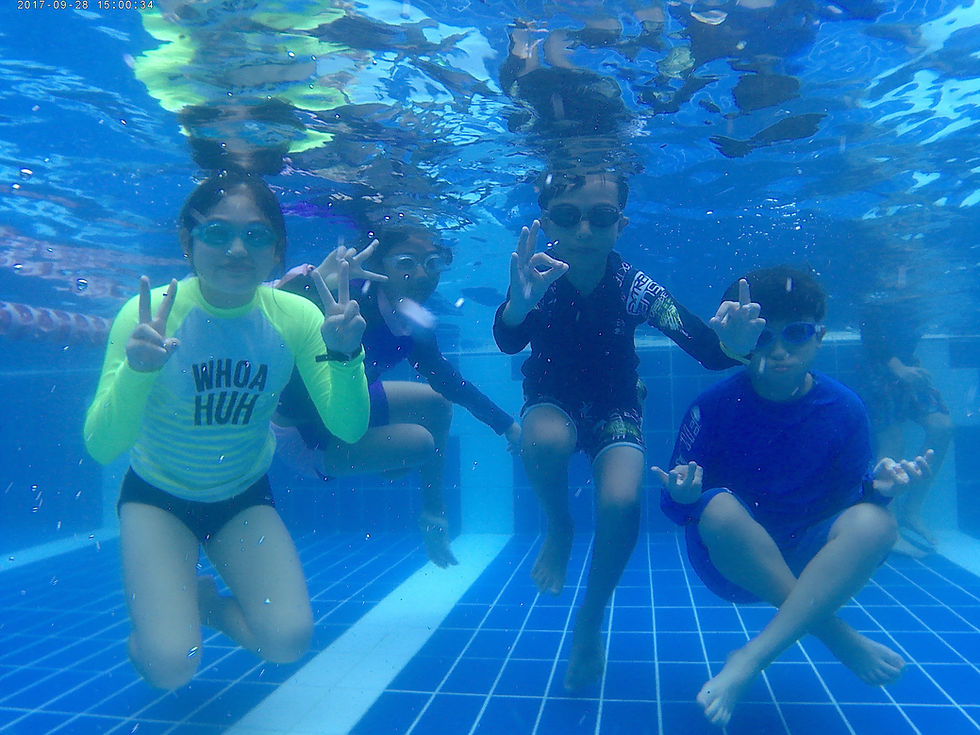
By Coach Tan Meng Chew (MC), SG Sink or Swim
Every year, around the time school swimming schedules are announced, I get the same message from parents: "My child's school is starting SwimSafer next term. Should I sign her up for lessons first? Or will the school teach everything from scratch?"
It is a fair question, and the honest answer is that it depends on your child. In this article I will explain what school SwimSafer looks like, what it assumes about your child, who really benefits from lessons beforehand, and how to decide without spending money you do not need to spend. I will also tell you where I think parents most commonly get this wrong, in both directions.
First, what "school SwimSafer" actually is
SwimSafer is Singapore's national water-safety and learn-to-swim programme. It has six stages: Stage 1, Stage 2, Stage 3, Bronze (Stage 4), Silver (Stage 5) and Gold (Stage 6). Each stage is about 12 hours of lesson time, and passing a stage means clearing both a practical in-water assessment and an online theory quiz.
There are two ways to enrol. Primary school students can register through their MOE schools, or families can register privately with an accredited SwimSafer instructor. School SwimSafer is the first route: it is delivered as part of the PE curriculum, usually in a block of lessons at a nearby pool.
The details vary from school to school. One primary school describes all its Primary 3 students taking part as part of PE, while another school's parent briefing describes a Primary 4 programme run as a block of PE periods at a designated venue. Some schools run lessons weekly and some run a concentrated block. So the first practical step is simple: check your own school's circular for which level takes part, how many sessions there will be, and how long each lasts. Do not assume that your cousin's school works the same way.
What is common across schools is the structure. Students are grouped according to their abilities, and at the end of the programme each student gets a chance to earn a SwimSafer certificate by passing both the practical and the theory assessments. That grouping by ability is the key to answering your question, so let me spend a moment on it.
What the school programme assumes
School SwimSafer is designed for mixed-ability groups. Some children arrive having never put their face in the water. Others arrive having already done Stage 3 or Bronze with a private school. Schools handle this by sorting children into groups so that each group works on a stage that matches its current ability.
This is helpful, because it means your child will not be thrown into the deep end just because he has not had lessons. A child with no experience is generally placed at the beginning of the pathway, and the programme starts from water confidence and basic skills.
But the structure also reveals the limits. A school programme works within a fixed number of sessions. A stage is about 12 hours of lesson time. Think about what that implies for a child starting from zero: if a school block gives, say, five or eight sessions, a total beginner is unlikely to move through many stages in one block. Stage 1 focuses on confidence, safe entries and exits, forward and backward movement and basic safety. Stage 2 aims for around 25 metres of continuous swimming. Those are real skills that take time, especially for a nervous child.
So the real question is not "will the school teach my child?" It will. The real question is "how far will my child get in the time available, and how will the experience feel for him?"
What the stages ask of a child, in plain English
To decide whether lessons beforehand would help, it is worth knowing what the early stages require. Based on the official syllabus, here is how I explain it to parents.
Stage 1 is an introduction to water skills. The objective is to build confidence and independence in the water, learn general and deep-end water safety, and practise forward and backward movement, safe entry and exit, and personal water safety. A child who is happy to enter the pool, put their face in, float with support and move a short distance is well on the way.
Stage 2 is about fundamental water skills: unassisted step entry, sculling, feet-first surface dives and water-safety knowledge in different aquatic environments. One of the goals is 25 metres of continuous swimming. This is the stage where many children hit their first real wall, because continuous swimming demands breathing control, not just brave legs.
Stage 3 introduces personal survival and stroke development, including entries such as the stride jump.
Bronze, Silver and Gold add progressively more demanding survival skills, stroke refinement and distances, up to 400 m timed at Gold.
If your child is going into school SwimSafer without experience, the school will begin at the early end of this ladder. If your child can already swim a length comfortably, the question becomes different: not "do they need lessons?" but "are they being assessed at the right level?"
The three kinds of children, and what I would advise
After years of coaching, I find that children fall into roughly three groups when they approach school SwimSafer. Here is what I advise for each.
Group 1: Complete beginners who are comfortable in water
These children can enjoy a pool, splash, get their face wet and maybe kick with a float, but they cannot swim unaided.
For them, school SwimSafer will probably be fine as a first experience, but I still recommend a small number of lessons beforehand if the budget allows. The reason is not that the school will fail them. It is that a block of group lessons with many children leaves little time for individual attention. A child who has already worked out how to blow bubbles, float on the front and back, and kick with straight legs will use the school sessions to progress rather than to catch up.
Even eight to twelve private or small-group lessons can make a visible difference to how much a beginner gains from the school block.
Group 2: Children who are afraid of water or have had a bad experience
These children are the ones I most strongly encourage parents to prepare before school begins.
A school lesson is a public environment. There are classmates, a whistle, a schedule, and a teacher who must look after a whole group. A child who is anxious can freeze, cry or refuse to enter, and a school session typically cannot slow down to a nervous child's pace. When a child has a bad first experience in front of classmates, the fear can deepen and the child may associate swimming with embarrassment.
For these children, a few weeks of gentle one-to-one or very small-group lessons before school starts is, in my view, one of the best investments a parent can make. The goal is not to teach strokes. It is to let the child feel safe: standing in the water, putting the face in, floating with support, and learning that the instructor will not let go before they are ready. When the school block arrives, the child walks in with a base of calm.
I would rather a child arrive at school swimming with a bit of confidence and no strokes than arrive with a few strokes and a knot in the stomach.
Group 3: Children who can already swim
These children can swim some distance and may know basic strokes, often because they learnt privately, on holiday, or from family.
The risk for this group is not lack of skill but mismatch. The school will place them according to ability, but a short school assessment may not capture everything. SwimSafer stages are defined by specific skills, including entries, sculling, floating and treading for set durations, survival sequences and timed distances. A child who swims freestyle nicely but has never done a stride entry or a timed tread may be placed lower than you expect.
If your child already has SwimSafer certificates from a private school, the school's own FAQ may guide what happens next. One primary school states that it accepts only certificates issued by ActiveSG for progression to the next stage, because those follow standardised assessment criteria. It also says in-house certificates from other schools can be submitted, but the school's contracted coaches will do a short assessment at the first lesson and recommend a stage that matches the child's ability. In other words, an official ActiveSG-issued certificate carries weight, and an in-house one may trigger a placement check.
For these children, more lessons are not necessarily needed. What helps is making sure the paperwork is in order and that your child has practised the specific skills of the stage they will be assessed on.
Is it compulsory to have lessons first?
No. School SwimSafer is built so that a child with no prior lessons can take part, and the programme begins at the introduction level. You are not required to have private lessons beforehand.
But "not required" is different from "not helpful". Think of it like learning to ride a bicycle: a child can certainly learn on the first day of a school cycling programme, and many do. Yet a child who has already wobbled around the car park with a parent holding the saddle will enjoy the first day more and learn faster.
What lessons beforehand can and cannot do
Let me be balanced, because I do not want to oversell lessons to anyone.
What lessons beforehand can do:
Build water confidence so the child is not overwhelmed in a large group.
Teach foundational skills such as breath control, floating and kicking, which make later stages easier.
Reduce the risk of a negative first experience.
Help a child who is already capable reach the right stage faster.
Give parents a realistic sense of where their child stands.
What lessons beforehand cannot do:
They cannot guarantee a certificate. Passing a stage requires clearing a practical assessment and a theory quiz with a 90% pass mark, and the practical needs full competency in the stage's skills.
They cannot replace the school programme. School SwimSafer is still the standard route for many families, and the certificate is issued through the national system.
They cannot fix a rushed schedule. If your child starts lessons two weeks before school, the benefit will be small.
When to start
If you decide lessons would help, timing matters. My general advice is to begin early enough that the child has real practice, not a last-minute crash course.
For a nervous child, I would aim for at least a couple of months before the school block. Fear does not dissolve on a deadline, and rushing can backfire.
For a beginner who is comfortable in water, six to eight weeks of weekly lessons is often a reasonable runway to learn floating, kicking and basic arm movements.
For a child who can already swim, a short refresher or a skills check may be enough, ideally a few sessions focused on the specific stage requirements.
In all cases, consistency beats intensity. One lesson a week for eight weeks usually works better than eight lessons crammed into a fortnight, because children need time between sessions to absorb new skills.
What about age?
Parents of younger children often ask whether they should start earlier than school. In my experience, the main point is readiness, not a specific birthday.
Children are usually ready for SwimSafer from around 5 to 6 years old, and younger children can start with baby or toddler classes. Singapore's national swimming framework also has earlier pathways. It includes a programme for babies and toddlers up to about 4 years old, where parents are in the water with the child, and one for children around 4 to 6 years old that builds independent water movement and confidence without a parent alongside. The latter is described as better preparing children for entry into SwimSafer.
So if your child is still some years away from school SwimSafer, there is a natural pathway: early water familiarity, then independent confidence, then SwimSafer. You do not have to rush a four-year-old into strokes. A relaxed, playful introduction to the pool is exactly what builds the base.
How to tell if your child is ready for school SwimSafer
Before I recommend lessons or no lessons, I ask parents to observe their child in a pool for ten minutes, ideally with no pressure. Here are the questions I use as a rough guide.
Does your child enter the water willingly, or do they cling to you?
Will they put their face in the water, or do they panic?
Can they float on their front and back, even briefly, with or without help?
Can they move a few metres by kicking or paddling?
Do they respond to simple instructions in the pool?
If the answer to most of these is "no", the child is at the very start of the journey and will benefit from some lessons first. If the answer is "yes" to most, school SwimSafer is likely to suit them as it is. If your child can swim well beyond these, then the focus is on getting assessed at the right level.
This is a rough tool, not a test. Children vary, and some who seem hesitant surprise you once they are in a good environment.
The cost question
Parents ask about cost, and I understand. Private lessons are an extra expense, and school SwimSafer is already part of the curriculum.
My view is that you should spend where it makes a difference. If your child is confident and curious, you may not need to spend anything before school. If your child is nervous, a modest investment in a few gentle lessons can prevent a bad experience that costs far more in lost enthusiasm later.
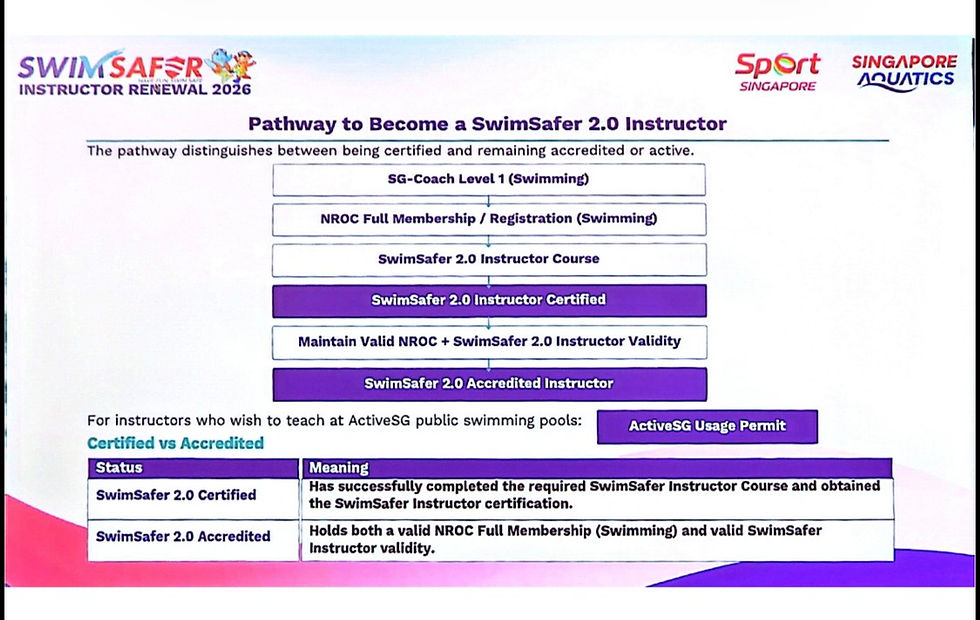
Look for instructors who are accredited, because SwimSafer instructors and assessors are required to hold valid SwimSafer 2.0 certification. Ask what their approach is for nervous children, how large their groups are, and how they track progress. Cheap lessons with a crowd of children per instructor may not give your child the individual attention that makes the difference.
A word on certificates
Whether your child learns at school or privately, the certificate matters. After a child passes both the practical and the theory components of a stage, parents receive an email from FileSG with a transaction ID and retrieve the e-certificate from the FileSG webpage. The older download option on the ActiveSG app is no longer in use, so keep those emails and download the certificates promptly.
Why does this matter before school? Because if your child takes private lessons and earns certificates, you will want them in order when the school asks. Authentic certificates issued through the national system are the ones schools can rely on for placement.
Common mistakes I see
Mistake 1: Waiting until the week before. A parent signs up for a handful of lessons in the last fortnight and hopes for a transformation. It rarely works. If you want the benefit, start early.
Mistake 2: Teaching strokes to a child who is not yet comfortable. Some parents focus on freestyle arms when the child cannot yet float or blow bubbles. Strokes sit on top of comfort. Build the base first.
Mistake 3: Assuming no lessons means failure. Many children start from zero at school and do perfectly well. Please do not panic if you cannot afford or arrange extra lessons. The school programme is designed to start at the beginning.
Mistake 4: Pushing a frightened child. Forcing a scared child into the water makes things worse. Patience and small steps work better than pressure.
Mistake 5: Not checking the school's details. Which level takes part, how many sessions, whether there is an external assessment and what the school accepts as prior certification can differ. Read the circular and ask the PE department if anything is unclear.
What happens after the school block
One more point. The school programme is often one stage of a longer journey. Many children complete a stage or two at school, then continue privately to reach Bronze, Silver and Gold. Some go on to endurance and lifesaving awards. If your child enjoys swimming, plan for the longer pathway rather than treating the school block as a one-off. Learning to swim is not a single course. It is a skill that stays only if it is practised.
So, does your child need lessons before school SwimSafer?
My answer, as someone who coaches children through this every week, is this.
Your child does not need lessons before school SwimSafer. The programme is built to take children from the beginning, and it groups them by ability. If your child is comfortable in water and keen to learn, the school block may be all they need to begin.
But lessons beforehand are worth it in three situations: when your child is anxious or afraid of water, when your child is a complete beginner and you want them to make the most of limited school sessions, and when your child already swims and you want to make sure they are placed at the right stage.
If you are unsure, start by watching your child in the water, check your school's circular, and then decide. A short assessment lesson with an accredited instructor can tell you a lot in one session.
At SG Sink or Swim, we teach within the national SwimSafer 2.0 framework, and a large part of what I do is help children arrive at school swimming with confidence rather than fear, whether that means a few gentle confidence-building lessons or a focused skills check for a child who can already swim. If you would like advice on where your child stands, you are welcome to get in touch through sgsinkorswim.com.
Coach Tan Meng Chew (MC) runs SG Sink or Swim, a Singapore swimming school and coaching brand serving the west side of Singapore.


Comments