

Is SwimSafer Recognised Overseas? What Singapore Parents Need to Know Before Moving Abroad


By Coach Tan Meng Chew (MC), SG Sink or Swim
If your family is planning a posting, a study stint or a permanent move abroad, you have probably asked whether your child's SwimSafer certificate will count for anything there. I get this question from parents at SG Sink or Swim several times a year, often just before a long-planned relocation to Australia, the UK, Canada or elsewhere in Asia. Their children may have just finished Stage 3 or Bronze, and the parents want to know whether the certificate buys their child a place in the right class at the new school.
The short answer is neither "yes, it is recognised everywhere" nor "no, it is worthless". The accurate answer is more nuanced, and I would rather give you that than a comforting line. I will explain what SwimSafer is, what its certificates formally do, what I could and could not verify about overseas recognition, and what you can do practically so your child is not set back when you move.
What SwimSafer actually is
SwimSafer is Singapore's national water-safety and learn-to-swim programme. It was introduced by the National Water Safety Council together with the Singapore Sports Council in July 2010, then reviewed in 2016–2017 and refreshed into SwimSafer 2.0. The enhanced version was rolled out in 2018 and runs across six progressive stages, from water confidence up to 400 m timed swims.
The six stages are Stage 1, Stage 2, Stage 3, Bronze (Stage 4), Silver (Stage 5) and Gold (Stage 6). Each stage comprises roughly 12 hours of lesson time. In broad strokes, Stage 1 builds confidence and independence in the water. Stage 2 aims at around 25 metres of continuous swimming. The later stages add stroke improvement, personal survival skills and more demanding distances and timings. At Gold, a child has a level of water competence that many adults in the world do not have.
Two features make SwimSafer different from a typical private swim school's "level 1 to level 10" ladder.
First, it is a water-safety programme as much as a swimming programme. It emphasises skill development together with water safety and personal water survival education. Your child is learning entries and exits, floating, treading, sculling, survival sequences and safety knowledge, not just freestyle and backstroke.
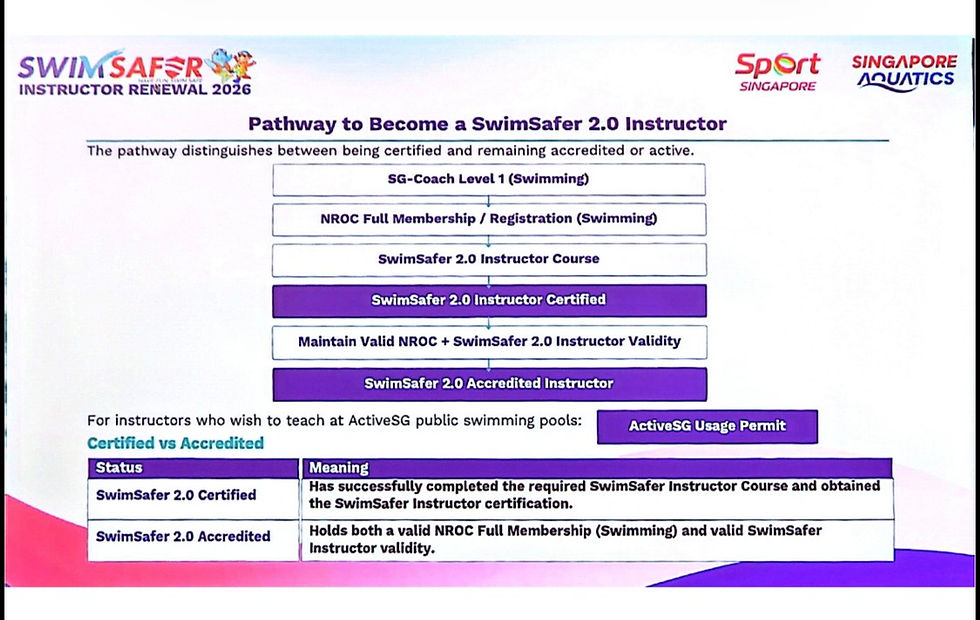
Second, it has standardised, externally controlled assessment. Every stage has two parts: a practical in-water assessment and an online theory quiz with a 90% pass mark. Programmes and assessments are conducted by SportSG-accredited SwimSafer 2.0 instructors and assessors. Since July 2025, registration, assessment and quizzes are managed on the national CAMS platform run by Singapore Aquatics, and e-certificates are issued through FileSG.
That standardisation matters when we discuss recognition, because a certificate is only as portable as the confidence others have in the process behind it.
What "recognised" means in Singapore
Before asking about overseas, it helps to see how recognition works at home.
Within Singapore, SwimSafer is recognised in a strong, institutional sense. It is embedded in the primary school system. One school's published FAQ states that only certificates issued under ActiveSG are accepted for progression to the next stage, because they follow standardised assessment criteria. The same FAQ says authentic certificates are officially recognised by schools, institutions and water-related sports, so a child who holds one can pursue further water-related programmes. Another primary school describes all its Primary 3 students taking SwimSafer as part of the PE curriculum.
So in Singapore, SwimSafer is the common language. A school, an ActiveSG pool, a CCA coach and a private instructor all understand what "Stage 3" or "Silver" means. That shared understanding is the real value of a national standard.
The question is whether that shared understanding travels.
The honest finding: no formal international recognition that I could verify
I looked for any official mutual-recognition arrangement, such as a Singapore agreement under which another country's swim authority or school system accepts SwimSafer stages as equivalent to its own levels. In the sources I checked, which included Singapore's official SwimSafer pages, school documents and the national framework documents, I did not find one. The recognition that is documented is domestic: schools, institutions and water-related sports in Singapore.
I want to be careful with what that does and does not mean.
It does not mean the certificate is fake or that the skills do not transfer. The skills are real and they transfer completely, because water competence is physical, not bureaucratic. A child who can swim 200 m on a timed basis and tread water for a couple of minutes can do that in a pool in Perth, Manchester or Vancouver.
It also does not mean that overseas schools will refuse to look at the certificate. Many will happily accept it as evidence of experience.
What it does mean is that, as far as I can verify, there is no automatic conversion. A UK swim school will not necessarily say "Bronze equals our Stage 5". An Australian programme will not necessarily place your child by reference to SwimSafer. Recognition overseas is informal, case by case and at the discretion of the receiving school or instructor. If a website claims otherwise, ask to see the document that establishes the equivalence.
I also want to flag a naming trap. If you search online for "SwimSAFER" you may find results that have nothing to do with Singapore's programme. For example, Swim Australia has an award called SwimSAFER, presented to swim schools for contributions to school and Indigenous swimming and water-safety programmes. The similar name is a coincidence. Do not assume that an Australian reference to "SwimSAFER" means your child's Singapore certificate has been recognised there.
Why formal recognition is genuinely hard
It helps to understand why swim certifications rarely cross borders automatically. This is not a Singapore problem. It is true of almost every country's learn-to-swim system.
Each country designs for its own risks. Singapore's programme reflects a city-state with pools, reservoirs, beaches and open water. A country with long beach and surf cultures designs around rips and currents. Cold-climate countries emphasise cold-water immersion and ice safety. A syllabus built for one environment does not map neatly onto another.
Levels are defined differently. "Level 3" in one framework might mean 10 metres unaided, while in another it might mean 50 metres of mixed strokes. Without a published crosswalk, a receiving school cannot simply translate.
Assessment control varies. Recognition depends on trust in who assessed the child and how. Singapore's system relies on accredited instructors and assessors. As far as I know, other countries run their own accreditation schemes, so there is no automatic trust between them unless two bodies sign an agreement.
Many learn-to-swim programmes are commercial or club-based. In several countries, the "level" your child holds is the property of a particular school or franchise, not a national standard. Receiving schools therefore tend to run their own placement test no matter what paper you bring.
All of this means the sensible expectation overseas is placement by observation. They watch your child swim, then put them in a suitable class.
Where SwimSafer certificates do help overseas
Although there is no formal recognition that I could verify, I would not tell parents the certificate is pointless. In my experience coaching in Singapore, and from what parents tell me after they move, the certificate is useful in several real ways.
It is credible evidence of structured training. A SwimSafer e-certificate from the national system shows that your child went through a defined syllabus with a theory and practical assessment. A receiving instructor can read "completed Silver, 200 m timed" and immediately form a rough picture of the child's ability. That is a better starting point than a parent's verbal estimate.
It gives you vocabulary. Parents can describe the child's skills in concrete terms: entries, floats, sculling, treading, distance, strokes. That makes the placement conversation faster and more accurate.
It supports a request for a skilled-level assessment. Where a school or club offers a placement trial, a certificate helps you argue for being assessed at the right level rather than being put in a beginner class by default.
It documents water-safety knowledge. Some schools and activity providers overseas, such as camps, outdoor education programmes and water-sports operators, ask about swimming competence and water-safety awareness. A recognised national certificate, even if not formally equated, can support a child's participation.
It is retrievable. Since certificates are issued through FileSG as e-certificates, parents are emailed by FileSG with a transaction ID once the practical and theory components are passed, and you retrieve the certificate from the FileSG webpage. That makes it easy to download and keep a copy before you leave Singapore. I will come back to this in the checklist below.
The Bronze Medallion pathway: where international recognition is more plausible
If a parent really wants a credential with wider international name recognition, I point them to the lifesaving side of the pathway. One Singapore primary school's swimming CCA page describes the progression this way: after achieving SwimSafer Gold, students are assessed for endurance swimming skills, then lifesaving awards, and finally the Bronze Medallion.
The Bronze Medallion is a lifesaving award with a long history in the Commonwealth, and lifesaving societies in several countries use similar-named awards. I have not verified any formal equivalence between the Singapore award and its overseas counterparts, so please do not take this as a guarantee. But because lifesaving awards are tied to international lifesaving networks more than learn-to-swim schemes are, they are more likely to be recognised by name abroad. If you are moving to a country with strong lifeguard and surf lifesaving culture, and your teenager might want to work as a lifeguard one day, this is worth investigating with the receiving country's lifesaving body directly.
Even then, treat it as "worth asking about", not as an entitlement. Overseas bodies typically want their own assessment.
Country by country: what to expect (in general terms)
I do not want to overclaim about other countries' systems, so I will keep this general and tell you how I would approach each situation.
Australia. Australian learn-to-swim is run through a mix of national frameworks and school-run programmes, and surf and open-water safety is a big part of the culture. Expect a placement assessment at a local swim school. Bring the certificate as supporting evidence. If you will live near the coast, consider extra open-water and surf-awareness lessons, because pool competence and surf competence are different things.
United Kingdom and Ireland. School swimming and club swimming have structured level systems, but each provider generally applies its own placement. Your child's SwimSafer stage will help the instructor judge where to start, but do not expect it to be converted formally.
Canada and the United States. Programmes are often run by municipal pools, community organisations and franchises, each with their own level names. Ask the facility for a free evaluation or "swim test". A confident Bronze or Silver child will usually test into an intermediate class.
Other Asian countries. Practices vary widely. International schools often have their own swimming programmes with in-house assessment. Ask the school's PE department what they require.
In every case, the pattern is the same: the receiving institution decides, and your best tools are the certificate, a short video of your child swimming, and an honest description of what the child can do.
Practical checklist before you move
Here is what I tell parents at SG Sink or Swim who are about to relocate.
Download and back up the e-certificates now. Retrieve every SwimSafer e-certificate from FileSG and save PDFs in at least two places. Do not rely on being able to log in from overseas later.
Record the exact stage and skills. Write down the stage completed, the date, the distances and timings your child achieved, and the strokes they can do. Concrete numbers are more useful overseas than a stage name.
Film a short skills video. A one-minute clip showing the child's entries, freestyle, backstroke, and treading water gives an overseas instructor instant information. Ask your coach to help you capture the right skills.
Ask the new school or pool about placement early. Contact the facility before you arrive. Ask whether they offer a free assessment and what they need to see.
Do not skip lessons during the transition. The biggest risk to a child's swimming ability during a move is not paperwork but a long gap with no pool time. Try to get your child back into water within a few weeks of arriving.
Match training to the new environment. If you are moving somewhere with cold water, surf, rivers or lakes, ask about local water-safety courses. Pool skills are the foundation, but different environments carry different hazards.
Keep the Singapore ladder in mind. If your child will return to Singapore later, keeping them progressing, even informally, makes it easier to resume SwimSafer stages at the right point. Only certificates issued under the national system will count for progression at home, as the school FAQ I mentioned makes clear.
A note on certificates that are not SwimSafer
Because Singapore has many swim schools, some parents hold in-house certificates, such as a school's own "Level 5" award, alongside or instead of SwimSafer certificates. These are fine as records of your child's learning, but they are less portable even within Singapore. One school's FAQ says it accepts only ActiveSG-issued SwimSafer certificates for stage progression, and that in-house certificates lead to a short placement assessment at the first lesson. The same logic applies overseas, even more strongly. If you are choosing a Singapore swim school with an eye to a future move, ask whether they teach and assess under SwimSafer 2.0 with accredited instructors, because a national certificate is easier for any third party to interpret than a private one. moe
So, is SwimSafer recognised overseas?
Here is my summary, which I would give to any parent sitting across from me.
SwimSafer is strongly recognised in Singapore, where it is built into schools and the national water-safety effort. I could not find evidence of formal, automatic recognition by overseas swim bodies or school systems, and I would be wary of anyone who says there is without showing you the agreement. Overseas, expect your child to be placed by a local assessment rather than by converting their SwimSafer stage.
That is not a reason for disappointment. The thing that really travels is your child's ability, and SwimSafer builds a lot of it: water confidence, safe entries and exits, floating and treading, stroke technique, endurance and safety knowledge. A child who has completed Bronze, Silver or Gold has a genuine foundation. The certificate is useful supporting evidence, and a short video plus a clear description of skills will do most of the work when you meet a new instructor.
If you are planning a move and want help, I am happy to talk it through. At SG Sink or Swim, we teach within the national SwimSafer 2.0 framework, and one of the things we try to do is prepare each child with real skills, not just a badge, so that the child can walk into any pool in the world and be placed correctly.
Coach Tan Meng Chew (MC) runs SG Sink or Swim, a Singapore swimming school and coaching brand serving the west side of Singapore. Learn more at sgsinkorswim.com.

Comments