

The Pathway to Becoming a SwimSafer 2.0 Instructor in Singapore: A Complete Guide

By Coach Tan Meng Chew (MC), SG Sink Or Swim
If you have ever watched a child take their first brave kick across a Singapore pool and thought, "I want to be the person who makes that moment happen," then you have probably wondered how one actually becomes a swimming instructor here. The answer is more structured than many people expect. In Singapore, teaching the national SwimSafer programme is not simply a matter of being a strong swimmer or having a friendly personality with children. There is a defined route, a set of credentials to earn, and a set of obligations to keep once you have earned them.
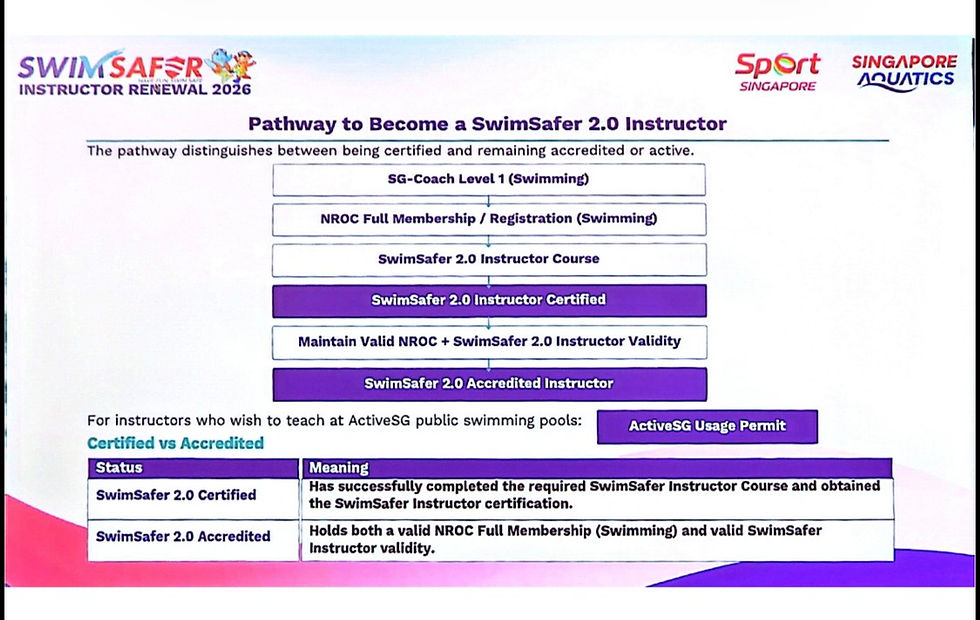
At the recent SwimSafer Instructor Renewal 2026 briefing, jointly presented by Sport Singapore and Singapore Aquatics. It was titled "Pathway to Become a SwimSafer 2.0 Instructor," and it carried a line that I think is the most important sentence in the whole presentation: the pathway distinguishes between being certified and remaining accredited or active.
I am Coach MC of SG Sink Or Swim, and in this article I want to walk you through that pathway step by step, explain what each stage means in practice, and clear up the most common confusion I hear from aspiring instructors and from parents: the difference between a "certified" instructor and an "accredited" one. Whether you are a National Serviceman thinking about a part-time job, a swimmer who wants to give back, a parent curious about who is teaching your child, or a current coach preparing for renewal, I hope this guide helps.
Why the Pathway Matters
Before we go into the steps, let me explain why Singapore has a formal pathway at all.
Water safety is not a hobby subject. Singapore is an island nation with pools in almost every neighbourhood, beaches, reservoirs and waterways. The SwimSafer programme exists so that children and adults learn not only to swim, but to survive and to behave safely in and around water. The quality of that education depends entirely on the quality of the people delivering it.
A formal pathway does three things. First, it sets a minimum standard, so that a parent can trust that an instructor has been trained and assessed. Second, it builds in accountability, because credentials must be maintained rather than earned once and forgotten. Third, it gives instructors a clear route for professional growth, which is good for the whole industry.
At SG Sink Or Swim, we believe parents deserve to ask, "Is my child's coach properly qualified?" and get a straightforward answer. Understanding the pathway is the first step to being able to ask that question well.
The Pathway at a Glance
The slide presented at the briefing shows six stages, flowing from top to bottom:
SG-Coach Level 1 (Swimming)
NROC Full Membership / Registration (Swimming)
SwimSafer 2.0 Instructor Course
SwimSafer 2.0 Instructor Certified
Maintain Valid NROC + SwimSafer 2.0 Instructor Validity
SwimSafer 2.0 Accredited Instructor
Two of these boxes are highlighted in purple on the slide: "SwimSafer 2.0 Instructor Certified" and "SwimSafer 2.0 Accredited Instructor." That highlighting is deliberate. These are the two statuses, and the steps in between are what take you from one to the other.
Below the flowchart, the slide adds a separate note for instructors who wish to teach at ActiveSG public swimming pools: they need an ActiveSG Usage Permit. We will come back to this, because it matters a great deal for anyone planning to teach in Singapore's public pools.
Let us go through each stage.
Stage 1: SG-Coach Level 1 (Swimming)
Everything begins with SG-Coach. SG-Coach is Singapore's national coaching accreditation framework, run under Sport Singapore, and it applies across many sports, not only swimming. Level 1 is the entry point.
Think of SG-Coach Level 1 as your foundation in the craft of coaching itself. Being able to swim well is a personal skill. Being able to teach someone else to swim is a completely different skill. Coaching education covers ideas such as planning a session, communicating clearly, managing a group, keeping participants safe, and understanding how people of different ages learn.
In my own experience, this is the stage where many talented swimmers have their first real surprise. A strong competitive swimmer may assume that teaching will be easy because the strokes come naturally. But natural ability is often the hardest thing to explain. Someone who has swum since childhood may never have consciously thought about why the body rolls a certain way or why the head position matters. Coaching education pushes you to break down what you do instinctively into steps a nervous beginner can follow.
A few practical points for aspiring instructors:
Requirements and course schedules can change, so always check the latest details with the relevant national bodies rather than relying on old information.
Expect both learning and assessment. This is a qualification, not an attendance certificate.
Start early. Course intakes fill up, and the whole pathway is sequential, so a delay at the first stage delays everything after it.
Stage 2: NROC Full Membership / Registration (Swimming)
The second box on the pathway is NROC Full Membership or Registration for swimming. NROC stands for the National Registry of Coaches, the national register of coaches in Singapore, which is administered under Sport Singapore.
Registration with NROC is what formally places a coach on the national register. It links a coach to a system of professional standards, and it is tied to expectations such as ethical conduct and safeguarding. For parents, the register is a valuable reference point, because it means a coach's status is not just a claim but something that sits within a national framework.
Notice something important about how the pathway is arranged. NROC appears twice. It appears here as step two, as a requirement on the way to becoming certified, and it appears again at step five, "Maintain Valid NROC + SwimSafer 2.0 Instructor Validity." This tells us something about how the system thinks. NROC membership is not a one-time hurdle; it is an ongoing condition. If it lapses, a coach's standing changes, which we will see clearly when we discuss accreditation.
For aspiring instructors, treat NROC registration as a living commitment. Keep track of your renewal dates, keep your records in order, and do not wait until the last minute.
Stage 3: The SwimSafer 2.0 Instructor Course
With the coaching foundation and national registration in place, you can move on to the course that is specific to the programme itself: the SwimSafer 2.0 Instructor Course.
SwimSafer is Singapore's national water safety and swimming programme, and it is structured in progressive stages. Version 2.0 refers to the updated programme. The instructor course is where you learn how to deliver it: what each stage is meant to achieve, what skills learners must demonstrate, how assessment is conducted, and how to run lessons that are safe, consistent and effective.
Why is a programme-specific course necessary when you already hold a coaching qualification? Because consistency is the whole point of a national programme. A child who completes a stage with one school should be assessed against the same standard as a child who completes it with another. Parents often tell us they have moved between swim schools, or that their child's friend learned at a different pool. The programme works only if instructors across Singapore interpret and apply it the same way.
The instructor course is how that shared understanding is built. It typically covers the structure of the stages, the content and criteria, teaching approaches suited to the programme, safety procedures, and the responsibilities that come with assessing children and adults.
Some advice from the pool deck:
Come prepared to be both a swimmer and a teacher. You will be expected to understand the technical standards in detail.
Pay attention to the assessment criteria. The most common cause of parent frustration I see is unclear communication about why a child did or did not pass a stage. An instructor who understands the criteria thoroughly can explain results honestly and kindly.
Take the safety content seriously. It is the reason the programme exists.
Stage 4: SwimSafer 2.0 Instructor Certified
Completing the course and meeting its requirements takes you to the first highlighted milestone: SwimSafer 2.0 Instructor Certified.
The slide defines this status precisely. A SwimSafer 2.0 Certified instructor "has successfully completed the required SwimSafer Instructor Course and obtained the SwimSafer Instructor certification."
That is worth reading carefully. Certified means you have done the course and earned the certification. It is an achievement, and a real one. But look at what the definition does not say. It does not say that you hold a valid NROC membership at this moment. It does not say that your instructor validity is current. It describes something you have completed, a past event, not an ongoing standing.
This is the subtle point that catches many people out. Being certified tells us about your training. It does not, by itself, tell us that you are currently in good standing to be teaching the programme. That is where the next two stages come in.
Stage 5: Maintain Valid NROC + SwimSafer 2.0 Instructor Validity
The fifth box on the flowchart is not a course or an exam. It is a condition: maintain valid NROC plus SwimSafer 2.0 Instructor validity.
This is the stage that makes the whole pathway a living system rather than a one-time qualification. Two things must both be kept valid:
Your NROC membership or registration, which we discussed at stage two.
Your SwimSafer 2.0 Instructor validity, meaning that your instructor status within the programme has not lapsed.
Why does the system insist on this? Because standards move. Programmes are updated, safety practices evolve, and the expectations placed on those who work with children and with the public change over time. Requiring instructors to maintain their status, and to go through renewal, ensures that the people teaching today are aligned with today's standards rather than the standards of the year they first qualified.
This is also precisely why the briefing was titled "Instructor Renewal 2026." Renewal is not an administrative afterthought. It is a core part of the pathway. If you plan to teach for years, and I hope you do, renewal will be a recurring part of your professional life. My advice is simple: put your renewal deadlines in your calendar the day you receive your certification, and set reminders well in advance.
Stage 6: SwimSafer 2.0 Accredited Instructor
The final box in the flowchart, the second one highlighted in purple, is SwimSafer 2.0 Accredited Instructor.
The slide's definition is clear: an accredited instructor "holds both a valid NROC Full Membership (Swimming) and valid SwimSafer Instructor validity."
Compare that with the definition of certified, and the difference becomes obvious. Let me put it plainly:
Certified is about what you have completed. You did the course, you earned the certification.
Accredited is about what you currently hold. Your NROC membership is valid, and your SwimSafer instructor validity is valid, right now.
An easy way to remember it: certified is the qualification you earned; accredited is the qualification you are keeping up to date.
The slide opens with the sentence that the pathway distinguishes between being certified and remaining accredited or active, and that sentence now makes complete sense. Someone can be certified without being currently accredited, for example if their registration has lapsed. Someone who is accredited is, by definition, someone whose credentials are both earned and current.
For parents, this distinction is practical. When you are choosing a swim school or a coach, "certified" is a good sign, but "accredited" is the fuller assurance. It tells you the instructor is not only trained but also currently in good standing within the national system.
The ActiveSG Usage Permit: Teaching in Public Pools
Below the main flowchart, the slide adds a separate box for instructors who wish to teach at ActiveSG public swimming pools. These instructors need an ActiveSG Usage Permit.
Many of Singapore's swimming lessons take place in ActiveSG public pools, which are among the most accessible and widely used facilities on the island. Because these are shared public facilities, access for coaching is managed. The permit is how that access is regulated, so that pools are used in an orderly, safe and fair way.
The important thing to understand is that the permit sits beside the pathway, not as a step within the linear flow. The slide places it as its own note, connected to the intention of teaching in public pools. In other words, completing the pathway and becoming certified or accredited is one matter, and obtaining permission to teach at ActiveSG facilities is a further requirement for those who plan to do so.
If your goal is to coach in public pools, plan for this early. Check the current application requirements and processes directly with ActiveSG, because details such as eligibility, documentation and timelines can change. Do not assume that finishing the instructor course automatically allows you to start teaching at a public pool.
Common Questions From Aspiring Instructors
Over the years, people have asked me many questions about this route. Here are the ones that come up most.
"Can I skip straight to the SwimSafer Instructor Course if I am already a strong swimmer?"Based on the pathway shown, the course comes after SG-Coach Level 1 and NROC registration, not before. Swimming ability alone does not replace the coaching foundation. If you are unsure about your own situation, check with the relevant bodies for the latest entry requirements.
"If I am certified, can I say I am an accredited instructor?"Not automatically. Certified and accredited are two different statuses. Accredited requires that you currently hold both a valid NROC Full Membership (Swimming) and valid SwimSafer Instructor validity. If either has lapsed, you are certified but not currently accredited.
"What happens if I let my NROC membership lapse?"The pathway makes the NROC requirement a continuing one, so a lapse would affect your accredited standing. The safest approach is to renew on time and never let it come close to expiry.
"Do I need a permit to teach in public pools?"For instructors who wish to teach at ActiveSG public swimming pools, the pathway indicates that an ActiveSG Usage Permit is required.
"Is the pathway a one-time effort?"No. The renewal emphasis of the 2026 briefing makes it clear that maintaining validity is an ongoing responsibility.
What Makes a Good Instructor Beyond the Paperwork
I want to be honest about something. Credentials matter, and the pathway is there for good reason. But credentials are the floor, not the ceiling. In all my years on the pool deck, the instructors who make the greatest difference share qualities that no certificate can fully guarantee.
Patience. A child who is afraid of water may need many sessions before putting their face in. Rushing produces tears, not progress.
Clear communication. Explaining a skill to a four-year-old and explaining it to a forty-year-old adult beginner are entirely different tasks. Good instructors adapt.
Safety awareness. Constant scanning, correct ratios, and calm, decisive action matter more than any technique.
Honesty with parents. Sometimes a child is not ready to advance. A good coach says so clearly and explains what is needed, rather than promising quick results.
Continuous learning. The requirement to maintain validity is a formal expression of an attitude every good coach already has: you are never finished learning.
How SG Sink Or Swim Approaches This
At SG Sink Or Swim, we take the pathway seriously, because we take our learners seriously. We serve families across the west of Singapore, and one of the most frequent things parents ask us is how to tell whether a coach is properly qualified. We encourage them to ask precisely the kinds of questions this pathway makes possible: Is the coach certified? Is the coach currently accredited? Is their registration valid? If they teach in a public pool, do they hold the necessary permit?
We believe that transparency builds trust. A parent handing over their child at the edge of a pool is placing enormous confidence in the person standing there. That confidence should be backed by real, current, verifiable credentials.
I would also gently encourage anyone considering a swimming career to see the pathway not as a set of obstacles but as a structure that protects both learners and instructors. When credentials are clear and standards are shared, everyone benefits: children learn more safely, parents choose with confidence, and good coaches are recognised for their commitment.
A Simple Checklist for Aspiring Instructors
If you are just starting out, here is the pathway condensed into an action list:
Complete SG-Coach Level 1 (Swimming).
Obtain NROC Full Membership or Registration (Swimming).
Attend and complete the SwimSafer 2.0 Instructor Course.
Earn your SwimSafer 2.0 Instructor Certified status.
Maintain valid NROC and SwimSafer 2.0 Instructor validity, and take part in renewal when it is due.
Achieve and keep your SwimSafer 2.0 Accredited Instructor status.
If you wish to teach at public pools, obtain an ActiveSG Usage Permit.
And remember the one-line summary: certified means you earned it; accredited means you have kept it current.
Final Thoughts
The pathway to becoming a SwimSafer 2.0 Instructor is clear, sequential and deliberately designed. It begins with a coaching foundation, moves through national registration and programme-specific training, and arrives at certification. But it does not stop there. The distinction between certified and accredited reminds us that in a field where safety is paramount, qualifications must be maintained, not merely collected.
For those willing to walk the path, the reward is enormous. There are few jobs where you can watch a frightened child become a confident swimmer within weeks, or help an adult finally conquer a lifelong fear of water. Every stage of the pathway exists so that when you stand at the pool's edge, you are ready for that responsibility.
If you are thinking about becoming an instructor, or you are a parent who wants to understand the credentials behind your child's coach, I hope this guide has made the process clearer. Requirements and procedures are updated from time to time, so always confirm the latest details with Sport Singapore, Singapore Aquatics, NROC and ActiveSG before making any decisions.
Coach Tan Meng Chew (MC) is the coach behind SG Sink Or Swim, which provides swimming lessons for children and adults across the west of Singapore.


Comments