

Who is allowed to teach SwimSafer?


By Coach Tan Meng Chew (MC), Founder and Head Coach, SG Sink Or Swim
Parents sometimes assume that anyone who can swim well, or anyone calling themselves a "swim instructor," can legitimately teach a child toward a SwimSafer certificate. That's not the case. SwimSafer is Singapore's national water safety programme, owned by Sport Singapore (SportSG) and run operationally by Singapore Aquatics (SAQ), and there's a specific, formal accreditation pathway that determines who's actually authorised to teach it and validate a child's readiness for assessment.
I'm Coach Tan Meng Chew, or MC, and I run SG Sink Or Swim, where our coaches are certified SwimSafer Instructors. This guide walks through exactly who's allowed to teach SwimSafer, what the accreditation actually involves, why it matters, and how you as a parent can check it for yourself.
What SwimSafer Actually Is
SwimSafer was introduced in July 2010 by the National Water Safety Council and enhanced in 2018 into SwimSafer 2.0, with a revised syllabus, tougher assessment criteria and stricter instructor certification. It remains the compulsory water safety foundation for primary school students under the Ministry of Education curriculum, and sits at the base of a broader national framework called SwimSingapore, launched by Singapore Aquatics, which organises six named programmes across participation, performance and recreational pathways.
There are six progressive stages in SwimSafer, and every stage ends with both a practical in-water assessment and an online water-safety theory quiz, with a 90% pass mark on the theory component. Since 1 July 2025, every assessment is booked, paid for and certified through a national platform called CAMS, the Centralised Assessment Management System, run by Singapore Aquatics.
The Core Rule: A Certified Instructor Must Validate Every Assessment
This is the single most important fact in this article. Under the SwimSafer registration process, a participant's assessment request requires validation by a certified SwimSafer instructor before it can even be booked through CAMS. In practical terms, this means a child cannot simply sign up for a SwimSafer test on their own, or through an uncertified instructor. A properly accredited instructor has to confirm the child is genuinely ready for the specific stage being registered, since higher stages are assessed in progressively deeper water, and Sport Singapore has publicly reminded instructors not to put children forward before they are actually prepared.
This validation requirement is exactly why the question "who is allowed to teach SwimSafer?" matters so much. If your child's instructor isn't properly accredited, they may not even be able to register your child for an assessment when the time comes, regardless of how well your child can actually swim.
The Accreditation Pathway: What a SwimSafer Instructor Must Hold
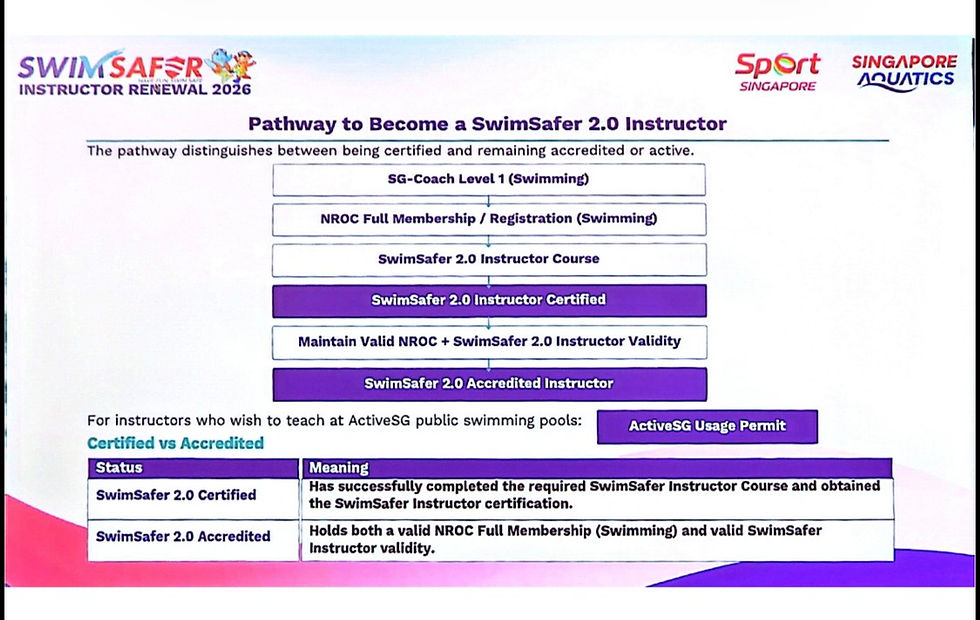
Becoming an accredited SwimSafer instructor in Singapore isn't a single certificate; it's a stack of several distinct qualifications, and all of them need to be in place and current.
1. National Registry of Coaches (NROC) membership. This is Sport Singapore's national coaching database and recognition framework, and it's foundational. You cannot teach in public ActiveSG pools or government schools without NROC membership. This confirms a recognised coaching qualification specific to swimming, along with an ongoing commitment to a code of ethics and continuing education.
2. A recognised swimming instructor certification. Singapore Aquatics runs its own local certification, the SG-Coach Level 1 Swimming Programme, developed in partnership with CoachSG and NROC. Alternatively, internationally recognised certifications such as AUSTSWIM, the Australian-developed qualification, or STA, are widely accepted by Singapore swim schools and SwimSafer providers, and are often the most common entry point for new instructors.
3. A lifesaving award. This is managed by the Singapore Life Saving Society (SLSS), and forms part of the baseline requirements set by Singapore Aquatics before an instructor can even enrol in the further stages of accreditation.
4. Standard First Aid certification. Instructors must hold a Standard First Aid certificate accredited by the Singapore Resuscitation and First Aid Council (SRFAC), including CPR and AED training. This is a safety essential, not a paperwork formality, given the setting instructors work in.
5. SwimSafer-specific accreditation. Beyond the general coaching and lifesaving qualifications above, an instructor needs specific accreditation to deliver the SwimSafer curriculum itself and to validate student readiness for CAMS assessments. Confirm whether a school or coach is specifically an accredited SwimSafer 2.0 provider, since this is distinct from general swim coaching credentials.
Taken together, becoming a fully accredited SwimSafer instructor from scratch, with no prior lifesaving awards, typically takes around 4 to 8 months, accounting for course schedules, a practicum attachment, and administrative processing time for NROC approval. Even for someone starting with some existing lifesaving qualifications, completing everything (lifesaving, first aid, theory, technical training and practicum) typically takes 3 to 6 months.
Instructor vs Assessor: Two Different Roles
It's worth understanding that "teaching" SwimSafer and "assessing" it are related but distinct roles.
A SwimSafer Instructor is accredited to teach the curriculum, validate a student's readiness, and register them for an assessment through CAMS.
A SwimSafer Assessor is a separate, further qualification, held by someone specifically trained and appointed to conduct the formal in-water and theory assessments themselves. Some swim schools specifically advertise having a CAMS-registered SwimSafer assessor on their team, since this allows students to be assessed on-site by someone from their own regular teaching team, rather than only by an unfamiliar assessor at a designated assessment venue. Not every instructor is also an assessor, and your child's regular coach doesn't need to be an assessor themselves for your child to progress through SwimSafer normally, since assessments are typically conducted by an appointed assessor at a designated centre.
Where SwimSafer Assessments Actually Happen
Assessments take place either at designated ActiveSG pool venues, or at officially recognised Non-ActiveSG Pool CAMS Centres. Some private facilities, such as country club pools, hold this official CAMS Centre status, which allows their students to complete SwimSafer 2.0 assessments on-site with nationally recognised results and certification, rather than having to travel to an ActiveSG pool for testing. If you're considering a provider that teaches at a non-ActiveSG venue, this is worth checking specifically: ask whether that venue is an officially recognised CAMS Centre, since that determines whether assessments taken there actually count nationally.
Why This System Exists
It's worth understanding the reasoning, since it explains why the rules are as strict as they are.
Safety first, always. Unlike many other children's activities, an unqualified or poorly trained instructor in the water can put children at genuine risk. The accreditation chain, NROC, lifesaving, first aid, SwimSafer-specific training, exists specifically to ensure that anyone teaching toward a national water safety certificate actually has the training to do so safely.
Consistency and national recognition. SwimSafer certificates, issued as e-certificates through FileSG, Singapore's official government document platform, are recognised by schools and institutions across the country precisely because the underlying accreditation and assessment system is standardised. If anyone could self-declare as a SwimSafer instructor, that national recognition would mean much less.
Protecting children from being rushed. Sport Singapore has explicitly reminded instructors, assessors and service providers of their responsibilities, particularly around not putting children forward for assessment before they're genuinely ready. The instructor validation requirement is the mechanism that enforces this, an accredited instructor is accountable for confirming readiness, which an uncertified person teaching informally simply isn't in a position to do within the official system.
How to Check If Your Child's Instructor Is Actually Certified
Given how many moving parts are involved, here's how to verify this yourself rather than taking a school's word for it.
1. Check the National Registry of Coaches. The official list of SportSG SwimSafer-accredited swimming instructors is maintained on CoachSG's National Register of Coaches, the same public database that covers NROC registration across all sports. Search for your instructor's name there.
2. Ask directly whether they hold SwimSafer 2.0 accreditation specifically. NROC registration alone confirms general coaching credentials; ask specifically whether the instructor or school is an accredited SwimSafer 2.0 provider.
3. Ask about their first aid certification currency. Standard First Aid certification, including CPR and AED, needs to be current, not simply obtained at some point in the past.
4. If lessons happen at a non-ActiveSG pool, confirm CAMS Centre status. Ask specifically whether that venue is an officially recognised Non-ActiveSG Pool CAMS Centre, since this affects whether assessments there count nationally.
5. Be wary of unofficial-sounding websites. Sport Singapore and Singapore Aquatics have explicitly noted that they are the only official sources for SwimSafer information, and that other websites using the SwimSafer name, or bearing similarity to it, are not connected to SportSG or Singapore Aquatics in any way. If a provider's claims about SwimSafer seem to come from an unofficial source, verify directly against Singapore Aquatics' own CAMS platform information.
Can Private, Independent Coaches Teach SwimSafer?
Yes, provided they hold the full accreditation described above. You can register privately with a SportSG SwimSafer-accredited swimming instructor, and the official instructor list on CoachSG's National Register confirms who qualifies. Private coaching isn't a lesser or unofficial route, it's a completely legitimate way to work toward SwimSafer stages, as long as the specific instructor holds current, verifiable accreditation.
This is worth knowing because private, one-to-one coaching often suits children who need more individual pacing than a larger group class allows, and there's no requirement to go through a school-based programme or a large commercial academy specifically. What matters is the instructor's accreditation, not the size or type of the organisation they work for.
What This Means When Choosing a SwimSafer Provider
1. Verify NROC registration and SwimSafer 2.0 accreditation specifically, using CoachSG's official register, rather than relying on a website's own claims.
2. Confirm current first aid and CPR/AED certification.
3. If considering a non-ActiveSG venue, confirm official CAMS Centre status, since this determines whether assessments there are nationally recognised.
4. Ask how the instructor approaches readiness for assessment. A properly accredited instructor should be able to explain, specifically, how they assess whether a child is ready to be registered for a stage, given that they're personally accountable for that validation under the CAMS system.
5. Be cautious of anyone promising a fixed timeline to a specific SwimSafer stage. Given that instructors are explicitly reminded not to rush students toward assessment, a provider guaranteeing a stage-completion date by a certain point is potentially working against the very safeguard this accreditation system is built around.
How SG Sink Or Swim Fits This System
Our coaches hold NROC-recognised swimming qualifications and are certified SwimSafer Instructors, with current first aid and CPR/AED certification. Ask us for the details and verify them yourself on CoachSG's National Register of Coaches.
We guide the CAMS process directly. Since assessments are booked, paid for and certified through CAMS, and since a certified instructor must validate every registration, we handle this step directly with families, confirming readiness honestly before any assessment booking is made, rather than rushing a student forward.
We prepare students across every SwimSafer stage. Our kids' lessons are structured with the full six-stage syllabus in mind, so the fundamentals we build in lessons are exactly what an assessment measures.
One coach, start to finish. From your child's first lesson to their final SwimSafer assessment, you work with the same certified coach, rather than a rotating roster, which matters for accurate, consistent readiness assessment over the course of a multi-stage journey.
Every age and format. Baby, toddler and kids lessons, adult beginner and stroke correction, ladies-only and senior lessons, special needs swimming, SwimSafer preparation and competitive training, across Bukit Batok, Bukit Panjang/Senja, Choa Chu Kang, Clementi and Tengah, plus condo lessons on request.
To ask about our coaches' specific SwimSafer accreditation, or to check readiness for a CAMS assessment booking, call (65) 9113 1462 or visit sgsinkorswim.com.
Frequently Asked Questions
Can anyone who swims well teach SwimSafer?
No. Teaching SwimSafer requires formal accreditation: NROC registration, a recognised swimming instructor certification, a lifesaving award, current first aid certification, and specific SwimSafer 2.0 accreditation. Swimming ability alone isn't sufficient.
What happens if my child's instructor isn't properly accredited?
An uncertified instructor cannot validate your child's readiness for a CAMS assessment booking, meaning your child may not even be able to register for the official test, regardless of their actual swimming ability.
Where do I check if an instructor is accredited?
CoachSG's National Register of Coaches maintains the official list of SportSG SwimSafer-accredited instructors.
Is a SwimSafer Instructor the same as a SwimSafer Assessor?
No. An Instructor teaches and validates readiness; an Assessor conducts the formal assessment itself. Not every instructor is also an assessor, and that's normal.
Can a private, independent coach teach my child toward SwimSafer?
Yes, provided they hold the full accreditation described above. Private coaching is a legitimate route, not an unofficial workaround.
Does it matter which pool the lessons happen at?
For teaching, not particularly, but for the formal assessment itself, it needs to happen either at a designated ActiveSG venue or at an officially recognised Non-ActiveSG Pool CAMS Centre for the result to count nationally.
How do I check if SG Sink Or Swim's coaches are accredited?
Ask us for their names and verify them yourself on CoachSG's National Register of Coaches.
How do I get started?
Book a trial lesson, and we'll assess your child's starting point honestly, guiding them toward SwimSafer readiness at the right pace, with proper accreditation behind every step.
Final Thoughts
SwimSafer's accreditation system exists for a genuinely good reason: teaching water safety to children carries real risk if done poorly, and the requirement for a certified instructor to personally validate every assessment registration is a deliberate safeguard against children being rushed into deep water before they're ready. Checking that your child's instructor holds current NROC registration and specific SwimSafer 2.0 accreditation takes only a few minutes on CoachSG's public register, and it's one of the most worthwhile checks a parent can make.
If you'd like to verify our coaches' accreditation, or talk through your child's SwimSafer journey, SG Sink Or Swim can help. You can reach us at (65) 9113 1462 or through sgsinkorswim.com, and we'll answer honestly and directly.

Comments