

ActiveSG Closes Outdoor and Non-Air-Conditioned Facilities in the West Because of Haze: What It Means for Your Child's Swim Lessons

By Coach Tan Meng Chew (MC), SG Sink or Swim
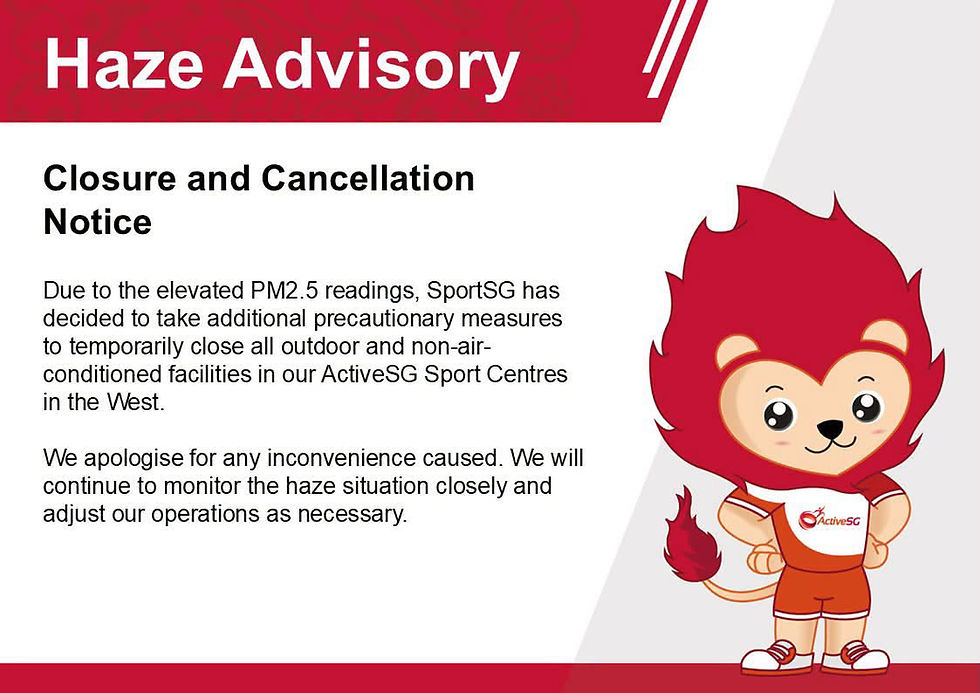
If you live or swim on the west side of Singapore, you may have seen a red-and-white notice doing the rounds on social media. It is an ActiveSG "Haze Advisory" titled Closure and Cancellation Notice, and it says that, "due to the elevated PM2.5 readings," Sport Singapore (SportSG) has decided "to take additional precautionary measures to temporarily close all outdoor and non-air-conditioned facilities in our ActiveSG Sport Centres in the West."
For a swim coach in the west, that sentence raises an immediate set of questions. Is the pool where my students train affected? Will tomorrow's lessons go ahead? How long will this last? And what should parents do in the meantime?
I'm Coach Tan Meng Chew, known to most people as MC. I run SG Sink or Swim, a swimming school and coaching brand serving the west side of Singapore, teaching from Nursery and Level 1 (Baby & Toddler) up to SwimSafer Stages 1 to 6. The areas named in this notice are exactly the neighbourhoods our families live in, so this one is close to home.
In this article, I will go through what the notice says and, just as importantly, what it does not say. I will explain how it fits with the haze readings we have seen recently and with Sport Singapore's haze plan. Then I will give you a practical guide to what to do about swim lessons while the closure is in place. I am a swim coach, not a doctor or a government spokesperson, so I will stick to what the published information says, mark clearly where I am reasoning, and send you to the official channels for anything that changes by the hour.
What the notice actually says
The notice comes in two forms: a graphic and a longer text post from ActiveSG Circle. Together they say the following.
The decision. Due to elevated PM2.5 readings, SportSG has decided to take "additional precautionary measures" to "temporarily close all outdoor and non-air-conditioned facilities" in its ActiveSG Sport Centres in the West.
The affected sport centres. The text post lists five areas:
Jurong East / Sport Village @ Jurong Town / Jurong Lake Gardens
Jurong West / Hockey Village @ Boon Lay
Bukit Batok / Bukit Gombak
Choa Chu Kang / Senja Cashew
Clementi
The tone. The notice apologises for any inconvenience, says SportSG will "continue to monitor the haze situation closely and adjust our operations as necessary," and ends with "Let's look out for one another and stay safe."
Where to check for updates. It points to two links:
For the latest facility closure updates: go.gov.sg/activesgfacilitiesclosure, or the respective Sport Centre's Facebook page.
For more information on the haze advisory: go.gov.sg/sporthazeadvisory.
A few things the notice does not say, which matter for swim families:
It does not name swimming pools, swimming complexes or swim lessons.
It does not give a date, a time window or an end point. The word used is "temporarily."
It does not say what happens to air-conditioned facilities. It only says that outdoor and non-air-conditioned ones are closing.
It does not give a specific PM2.5 number or threshold that triggered the decision.
I will come back to each of these, because the gaps are where most of the confusion arises.
Why PM2.5, and why now?
The recent haze picture
The notice follows several days of poor air in Singapore. According to reports I read from 9 and 10 October 2026:
On 9 October, the 24-hour PSI ranged from 102 to 147 at 2 am and from 117 to 173 by 10 am, with the central region recording 170 at 9 am, reported as the highest in Singapore in 2026 so far. The western region's 1-hour PM2.5 hit 171 at 2 am, in what the National Environment Agency (NEA) classes as the "high" range of 151 to 250, before dipping to 114 by 10 am. The west was the haziest region for much of that night.
On 10 October, afternoon showers brought a little relief from about 4 pm, but air quality stayed unhealthy. As of 7 pm, the 24-hour PSI was 186 in the central region and 152 in the west, with 1-hour PM2.5 readings in the elevated band across all five regions.
NEA said smoke plumes from Sumatra and Kalimantan were drifting towards Singapore, and that winds could keep bringing haze here. The reports also said the Haze Task Force was ready to activate the next tier of its action plans if air quality reached the "very unhealthy" range.
I do not have the live readings for today, and conditions can change within hours, so please check the current numbers yourself on the official haze website (haze.gov.sg) before making any plans. What the figures above tell us is the background: the west has been among the most affected regions, which fits with SportSG singling out its western sport centres.
24-hour PSI versus 1-hour PM2.5
Two kinds of readings show up in haze reports, and they do different jobs.
The 24-hour PSI is the headline number used for planning. Sport Singapore's haze page says facility decisions are primarily based on the 24-hour PSI forecast.
The 1-hour PM2.5 reading captures what is happening right now. Sport Singapore describes it as supplementary information for immediate activity decisions.
This notice cites "elevated PM2.5 readings," which tells us the decision was driven by the short-term, in-the-moment picture and not only by the daily PSI band.
How this compares with Sport Singapore's haze plan
Here is where I want to be careful, because I am interpreting. Sport Singapore's Haze Management Plan (April 2026) sets out phases by 24-hour PSI. As I read it:
24-hour PSI | Outdoor or non-air-conditioned facilities | Air-conditioned facilities |
0 to 50 | Open | Open |
51 to 100 | Open | Open |
101 to 200 | Operate with conditions | Open |
201 to 300 | Close | Operate with conditions |
Above 300 | Close | Close |
For the 101 to 200 band, the plan says organisers must carry out a risk assessment before continuing activities, and anyone feeling unwell must stop and seek medical attention. It also says the 1-hour PM2.5 reading can inform immediate decisions, and that short spikes may improve within one to two hours.
On the 24-hour PSI figures I saw for the west on 10 October (152), the plan would put outdoor and non-air-conditioned facilities in the "operate with conditions" phase. The notice you shared describes a stricter step, a temporary closure, and calls it "additional precautionary measures." So it appears SportSG has chosen to go further than the baseline for that band, in response to elevated PM2.5 readings. That is my reading of the wording, not something the notice spells out, but "additional" strongly suggests it.
I think that is reassuring in its own way. It shows the operator watching the real-time air, not just waiting for a daily number to cross a line.
One more observation: when I looked at the ActiveSG facilities closure page, which showed information as of 11 October 2026, its haze banner said the 24-hour PSI was in the 101 to 200 band, that "ActiveSG facilities remain open," and that outdoor activities and programmes "may be adjusted based on prevailing haze conditions." It did not list the closure you are seeing now. The notice is undated in the images, so I cannot tell you exactly when it was issued, but it is a good reminder that the situation moves faster than any single web page. The ActiveSG page itself says same-day closures may not appear immediately and advises checking the relevant Sport Centre's Facebook page.
The big question: is my swimming pool closed?
This is the question that matters most to swim families, and I want to give you a straight answer: the notice does not tell us, and I cannot tell you either.
The notice says "outdoor and non-air-conditioned facilities." Whether a particular swimming pool counts as one of those depends on how the venue is built and how SportSG classifies it. In the documents I read, including the haze plan, there was no statement of how swimming pools and swimming lessons are classified. And the notice does not mention pools at all.
Here is how I think about the possibilities. This is general reasoning, not an official classification.
A fully open outdoor pool is the clearest case of an "outdoor" facility, so it is the type I would expect to be affected.
A covered but open-sided pool may count as non-air-conditioned, even with a roof, though I cannot confirm how it is treated.
An enclosed, air-conditioned pool hall may fall on the other side of the line, but the notice does not say, and I would not assume.
Because I cannot tell you which category your pool falls into, the right move is to ask. The two links in the notice are the places to start:
go.gov.sg/activesgfacilitiesclosure for the latest facility closure updates.
The Sport Centre's own Facebook page for same-day changes.
go.gov.sg/sporthazeadvisory for the haze advisory and Sport Singapore's measures.
If your child's lessons are with a swim school or coach at an ActiveSG pool, your provider should also be able to tell you what is happening at that venue and whether your lesson is on or off. If you are not sure, message them. Please do not turn up at a pool on the assumption that it is open.
One more practical point. The closure page also lists planned closures for upgrading and maintenance, which are separate from haze. When I looked, it showed items such as the Clementi Swimming Complex training pool, the Jurong West Swimming Complex fun pool, water slide and lazy river, and the Jurong East Swimming Complex competition pool among its entries, and noted that same-day closures may not appear straight away. If your lesson is cancelled, it may not be haze at all, so check the reason.
What this means for children's health and safety
Why close facilities at all? Because the official guidance asks for extra caution with children, and swimming lessons are mostly for children.
The NEA's activity guidance groups people into healthy persons; elderly, pregnant women and children; and people with chronic lung or heart disease. At 24-hour PSI 101 to 200 (Unhealthy), healthy people are advised to reduce prolonged or strenuous outdoor physical exertion, children to minimise it, and people with chronic lung or heart disease to avoid it. At 201 to 300 (Very unhealthy), the advice tightens further. (The text of the NEA file I read came out jumbled when extracted, so I mapped its table by order. The Ministry of Health's FAQ states the same bands in prose, but please check haze.gov.sg for the current version.)
For the 1-hour PM2.5 reading, a news report of NEA's advice said that at the elevated level, healthy people should reduce strenuous outdoor activity for the next hour, while the elderly, pregnant women, children and people with chronic heart or lung conditions should avoid such activity. I only have that second-hand, so please confirm it on NEA's own channels.
The Ministry of Health says haze can cause respiratory symptoms and worsen existing heart or lung disease, that healthy people may experience eye, nose and throat irritation that usually resolves on its own, and that effects can appear one to three days after exposure. HealthXchange explains that children are more vulnerable because their lung defences are still developing, and that children with asthma or allergic conditions may get more severe symptoms. I have written about the respiratory question in more detail elsewhere, and the short version is this: the harder you breathe in poor air, the more of it you take in, and children are the group where I would rather be cautious.
So a temporary closure of outdoor and non-air-conditioned facilities is, in my view, a sensible and protective step. A missed swim lesson is easy to recover from.
What to do right now: a parent's checklist
Here is the practical routine I would follow if my child had a lesson in the west today.
1. Check the official channels, not just your group chats. Look at go.gov.sg/activesgfacilitiesclosure, the Sport Centre's Facebook page and your swim provider's message. Rumours travel faster than facts.
2. Check the current readings. Look at the latest 24-hour PSI and 1-hour PM2.5 on haze.gov.sg. HealthHub and Sport Singapore both describe the 24-hour PSI as the planning measure and the 1-hour reading as the guide for immediate decisions.
3. Find out your pool's status. If you do not know whether it is outdoor, covered or air-conditioned, ask the venue or your coach.
4. Look at your child. Is your child well? Any coughing, sneezing, eye irritation or breathing difficulty? If your child is unwell, skip, whatever the venue says.
5. If your child has asthma or another breathing condition, follow your doctor's plan. Keep prescribed medication readily available. HealthXchange says children with asthma should follow their asthma action plan if the PSI is above 100 and they have cough, wheezing or shortness of breath.
6. Do not "make up" the lesson somewhere else on the same day. If a facility has closed for air-quality reasons, finding another outdoor pool defeats the purpose.
7. Ask about make-up lessons. Your provider should be able to tell you how cancelled lessons are replaced.
8. Keep things calm at home. Tell your child, "Today the air is not good for swimming, so we are looking after our lungs. We will swim again soon." Children take their cue from you.
9. Keep the air at home as clean as you reasonably can. The official advice includes keeping doors and windows closed when outdoor air is worsening, keeping air-conditioner filters clean, and avoiding smoking indoors. Drink plenty of water.
10. Watch for delayed symptoms. Because effects can lag exposure by one to three days, keep an eye on how your child feels over the next few days.
Warning signs: when to seek help
Whatever is happening at the pool, seek medical advice if you see:
Persistent or worsening coughing.
Wheezing, a whistling sound when breathing.
Difficulty speaking in full sentences because of breathlessness.
Chest tightness or chest pain.
Unusual paleness, bluish lips, dizziness or faintness.
A child who looks distressed or cannot catch their breath.
The official advice is that vulnerable people who feel unwell should seek medical attention promptly. In an emergency, such as severe breathing difficulty, call for emergency help immediately.
Will the closure hurt my child's swimming progress?
I get this question every time lessons are cancelled, so let me answer it here.
A short closure is unlikely to damage progress in a lasting way. A few missed lessons are usually recoverable, and a gentle review session when lessons resume tends to get children back on track. Longer gaps carry more risk, particularly for young children and nervous swimmers, whose progress rests on comfort and routine. These are general coaching observations, and every child is different.
The research I found on skill retention is limited. One Australian study from Deakin University found that children who relied only on intensive school programmes often could no longer swim a year later, and that weekly lessons helped maintain skills. That is about year-long gaps, not a few hazy days, so I would not read it as a prediction for this closure. But it does support the idea that regular practice matters over the long run, which is why a plan to resume is more important than any single missed lesson.
Singapore's SwimSafer 2.0 programme can help. According to the official ActiveSG description, it has six progressive stages of about 12 hours of lesson time each. Because your child's progress is tied to defined stages, a coach can check what has been mastered and pick up from the right point after a pause. You are continuing along a marked path, not starting over.
While you wait, you can keep water familiarity going safely at home with bubble blowing in the bath, gentle water play, songs, and kicking movements practised on dry land. Always supervise children around water.
How SG Sink or Swim responds to a closure like this
The sport centres named in the notice cover the part of Singapore we serve, so let me explain how I handle situations like this. I should be honest that I am describing principles here, and the details can vary by venue and by day.
Safety first
If a venue closes or suspends activities, our lessons there are off. Official guidance asks for extra caution with children, who make up most of our students, and I would always rather reschedule than push a child through poor air.
We check the venue and the readings on the day
Conditions can change within hours, as the closure page's own advice about same-day updates shows. So we look at the venue's notices and the latest readings, not at yesterday's news.
We tell families early
Where we can, we let families know promptly when a lesson needs to change, and we talk through make-up arrangements, so nobody is left guessing at the pool gate.
We adjust rather than cancel only when it is safe to do so
If a venue is open and conditions are borderline, a gentler session focused on water confidence, floating, kicking and breathing rhythm may be appropriate for a healthy child. But when a facility is closed, there is nothing to adjust. And for children with breathing concerns, I follow their doctor's advice over any general rule.
We keep progress visible through a pause
Our programmes run from Nursery and Level 1 (Baby & Toddler), through Level 2 (Beginner) and Level 3 (Intermediate), and on to SwimSafer Stages 1 to 6. Because progress is tied to that pathway, a haze closure does not leave families wondering where their child stands. We can restart from the right point, with a gentle first lesson back if needed.
We want to know about your child's health
If your child has asthma, allergies or any breathing-related concern, please tell your coach and let us know where prescribed medication is kept. It helps us watch for the right things.
If you would like to talk about how lessons will work during the closure, or what a restart plan could look like for your child, you are welcome to get in touch through sgsinkorswim.com.
Frequently asked questions
Does this notice mean all swimming pools in the west are closed?
Not necessarily. The notice refers to "outdoor and non-air-conditioned facilities" in ActiveSG Sport Centres in the West, and does not mention pools by name. The documents I read do not say how swimming pools are classified. Check the facility closure page, the Sport Centre's Facebook page and your provider.
Which sport centres are affected?
The notice lists Jurong East / Sport Village @ Jurong Town / Jurong Lake Gardens; Jurong West / Hockey Village @ Boon Lay; Bukit Batok / Bukit Gombak; Choa Chu Kang / Senja Cashew; and Clementi.
How long will the closure last?
The notice says "temporarily" and does not give an end date. SportSG says it will keep monitoring the haze and adjust operations as necessary. Short spikes in PM2.5 can improve within one to two hours, according to Sport Singapore's plan, but I cannot predict how this will unfold.
Why was this decided on PM2.5 and not the PSI?
The notice cites elevated PM2.5 readings. Sport Singapore describes the 1-hour PM2.5 reading as supplementary information for immediate activity decisions, alongside the 24-hour PSI used for planning. The notice describes the closure as an "additional precautionary measure."
Are air-conditioned facilities open?
The notice does not say. It only announces the closure of outdoor and non-air-conditioned facilities. Sport Singapore's plan treats air-conditioned facilities more leniently, but venue decisions can change, so check before you go.
Where do I check for updates?
The notice points to go.gov.sg/activesgfacilitiesclosure for facility closure updates, the respective Sport Centre's Facebook page, and go.gov.sg/sporthazeadvisory for the haze advisory. For the air-quality readings themselves, use haze.gov.sg.
Will I get a make-up lesson?
That depends on your provider's policy. Ask them directly.
Is it safe to take my child to a different pool instead? If the reason for the closure is air quality, an alternative outdoor pool has the same problem. If you are considering an enclosed pool, ask the venue about its status, and keep your child's health and your doctor's advice first.
Should my child wear a mask to the pool?
N95 masks are not needed for brief trips between buildings or for indoor use, according to HealthHub, and HealthXchange notes they may not fit children well. Ask your doctor what is appropriate for your child.
My child coughed after swimming recently. Should I worry?
A single cough can have many causes, including swallowing water or a cold. But haze effects can appear one to three days later, so keep watching. If coughing, wheezing or breathlessness persists or recurs, see a doctor.
The bottom line
ActiveSG has announced a temporary closure of outdoor and non-air-conditioned facilities in its western Sport Centres because of elevated PM2.5 readings. The five areas named are Jurong East, Jurong West, Bukit Batok, Choa Chu Kang and Clementi.
The notice does not name swimming pools, give an end date or say what happens to air-conditioned facilities. Do not guess. Check the official links and your provider.
It appears to be a stricter step than the baseline for the PSI band we have been in, and the notice calls it an "additional precautionary measure." That is my reading, and it suggests operators are responding to real-time air quality.
Children deserve extra caution, and a rescheduled lesson is a small price. Follow your doctor's advice if your child has a breathing condition.
A short pause rarely undoes progress. What helps is a clear plan to resume, and a coach who knows where your child left off.
Haze episodes pass, and a child's swimming journey is long. The families who do best stay informed, stay calm, keep in touch with their coach and get back into a regular rhythm as soon as the air clears.
At SG Sink or Swim, we teach from a child's very first splash through to SwimSafer Stage 6, and keeping swimmers safe is always part of the job. If you have questions about your child's lessons during this closure, reach out at sgsinkorswim.com.
Stay safe, breathe easy, and see you at the pool when the air is clear.
Coach Tan Meng Chew (MC) SG Sink or Swim | sgsinkorswim.com
Comments