

Outdoor Pool or Indoor Pool During Haze: Which Is Safer?

By Coach Tan Meng Chew (MC), SG Sink or Swim
When the haze arrives, one question lands in my inbox again and again: "MC, is it better to swim at an indoor pool than an outdoor pool when the air is bad?"
It sounds like it should have a simple answer. Indoors means a roof and walls, outdoors means open sky and whatever is floating in it. Surely indoor is safer?
The honest answer is: often, probably yes, but it is not a guarantee, and the official guidance is less specific about swimming pools than most people assume. In this article I will walk you through what Singapore's official sources actually say, where they go quiet, how I reason about the difference between pool types as a coach, and how to make a sensible choice for your family.
I'm Coach Tan Meng Chew, known to most people as MC. I run SG Sink or Swim, a swimming school and coaching brand serving the west side of Singapore, teaching from Nursery and Level 1 (Baby & Toddler) all the way up to SwimSafer Stages 1 to 6. I am a swim coach, not a doctor or an air-quality engineer, so I will be clear throughout about what is official guidance, what is my own reasoning, and what you should ask a doctor.
The short answer
If you want the quick version, here it is:
Official guidance is mostly framed around outdoor exertion. The activity advice from the National Environment Agency (NEA) talks about reducing, minimising or avoiding outdoor physical exertion as the PSI rises.
Sport Singapore treats outdoor and non-air-conditioned facilities more strictly than air-conditioned ones. At higher PSI levels, the former close first.
None of the documents I read says how swimming pools are classified. So whether a given pool counts as "outdoor", "non-air-conditioned" or "air-conditioned" for haze purposes is something to confirm with the venue.
In general, a well-enclosed, properly ventilated indoor pool is likely to expose swimmers to less haze than a fully open outdoor pool, but "indoor" does not automatically mean "haze-proof."
Whatever the venue, an unwell child or a child with a breathing condition should follow a doctor's advice, not a general rule.
The rest of this article explains the reasoning behind each point.
What the official sources say
Let me start with what we actually know. I read the relevant Singapore guidance while preparing this article, and I will keep to what those documents say.
The activity guidelines are about outdoor exertion
The NEA's advisory on planning outdoor activities during haze sets out activity advice by 24-hour PSI band and by group: healthy persons; elderly, pregnant women and children; and people with chronic lung or heart disease. Based on the document I read, the advice runs like this (the text came out jumbled when extracted, so I have mapped the table by its order. Please check it against haze.gov.sg before relying on it):
24-hour PSI | Healthy persons | Elderly, pregnant women, children | Chronic lung or heart disease |
0 to 100 | Normal activities | Normal activities | Normal activities |
101 to 200 (Unhealthy) | Reduce prolonged or strenuous outdoor physical exertion | Minimise prolonged or strenuous outdoor physical exertion | Avoid prolonged or strenuous outdoor physical exertion |
201 to 300 (Very unhealthy) | Avoid prolonged or strenuous outdoor physical exertion | Minimise outdoor activity | Avoid outdoor activity |
Above 300 (Hazardous) | Minimise outdoor activity | Avoid outdoor activity | Avoid outdoor activity |
Every row says outdoor. That tells us the official concern is about breathing hard in polluted outdoor air. It does not say that indoor exercise is automatically fine, and it does not say it is automatically a problem. It simply does not address it.
Sport Singapore draws a line between outdoor and air-conditioned facilities
Sport Singapore's Haze Management Plan (April 2026) organises its response in phases by 24-hour PSI. Based on the summary I read:
24-hour PSI | Outdoor or non-air-conditioned facilities | Air-conditioned facilities |
0 to 50 | Open | Open |
51 to 100 | Open | Open |
101 to 200 | Operate with conditions | Open |
201 to 300 | Close | Operate with conditions |
Above 300 | Close | Close |
In the 101 to 200 phase, organisers must carry out a risk assessment before continuing activities, and anyone feeling unwell must stop and seek medical attention. At 201 to 300, outdoor activities are suspended while air-conditioned facilities may continue with risk management measures. Above 300, all facilities close and organised activities are suspended.
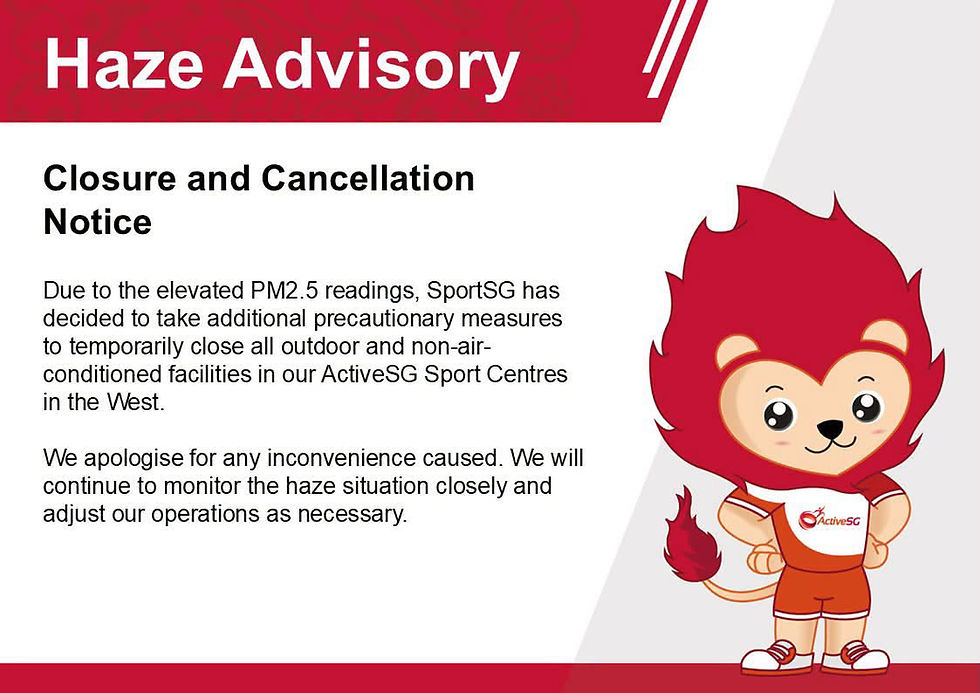
An older set of Sport Singapore haze advisories I also read follows the same logic: at 201 to 300 it calls for temporary closure and suspension of programmes in outdoor and non-air-conditioned facilities, and above 300 it calls for temporary closure of all sport facilities at ActiveSG sport centres.
So officially, the regulator treats air-conditioned spaces as lower risk than outdoor and non-air-conditioned ones. That supports the general idea that enclosed, air-conditioned venues are the more conservative choice during haze.
But the documents do not say how pools are classified
Here is the catch. When I read the Haze Management Plan, it did not mention swimming pools or swimming lessons, and it did not say how pools fall into the categories above. The older advisories also did not mention pools by name, and they did not cover the 101 to 200 band at all. A recent NEA announcement on government measures also did not mention swimming pools.
That means I cannot responsibly tell you, "Pool X will be treated as outdoor and will close at PSI 201." What I can tell you is that the framework distinguishes outdoor and non-air-conditioned facilities from air-conditioned ones, and that you should ask your venue how it applies the framework to its pool.
Indoor activity is not exempt from caution
One more detail from the NEA's recent announcement is worth noticing. It said that when air quality is in the Unhealthy range, preschools limit long outdoor play and also minimise strenuous indoor physical activities for children, and that children with chronic heart or lung conditions are exempted from outdoor activities and exercise. The same announcement noted that on 4 September 2026 the 24-hour PSI reached the Unhealthy range for the first time since 8 October 2023.
So even in official guidance for young children, "indoors" is not treated as a free pass for hard exercise. Intensity still matters.
General advice about indoor air
Indoor air-quality advice from the sources I read includes:
Close doors and windows when outdoor air is worsening.
Using an air-conditioner helps remove pollutants.
Air purifiers can capture very small particles.
Avoid smoking indoors and use wet-cleaning rather than dry dusting.
N95 masks are not needed for brief trips between buildings or for indoor use.
These are tips aimed mainly at homes and enclosed rooms. They hint at the principle behind the outdoor-versus-indoor question: what matters is how much haze-laden air reaches your lungs, and for how long.
Why an enclosed indoor pool may be the better choice
Let me explain my reasoning as a coach. This is general reasoning, not an official ruling, and I will mark where I am speculating.
Less direct exposure. At a fully open outdoor pool, your child breathes outdoor air for the whole lesson, often with sustained effort. At an enclosed pool hall, a building envelope sits between your child and the outdoors. If the building is well sealed and the air handling is sound, the amount of haze reaching the pool deck can be lower.
Air-conditioning and filtration may help. Sources I read say that air-conditioning helps remove pollutants at home, and Sport Singapore's framework treats air-conditioned facilities more leniently. Whether a particular pool hall actually filters fine particles depends entirely on its system, which I cannot assess from the deck.
Fewer weather swings. Indoor pools offer a stable environment. That is separate from haze, but it means one less factor affecting a child who is already sensitive.
Operationally clearer. Because the Sport Singapore framework distinguishes air-conditioned facilities from outdoor ones, indoor venues have a clearer rule for staying open under conditions.
Why "indoor" does not mean "haze-proof"
Now the other side. Here are reasons I would not tell any parent to relax just because the pool has a roof.
Many pools are not fully enclosed. In Singapore, plenty of swimming venues are open-sided, partially covered, or naturally ventilated. A roof keeps off the rain and sun but does little for air quality. I would treat such pools as closer to outdoor for haze purposes unless the venue tells you otherwise. This is my reasoning, not an official classification.
Ventilation brings outside air in. Any building that exchanges air with the outdoors will let some haze in. How much depends on the ventilation design, filtration, door traffic and whether the system recirculates air. I cannot judge that from a pool deck.
Indoor pool air has its own considerations. Indoor pool halls can have humid air and the smell of pool chemicals, and some people find that irritating. If a child consistently coughs or wheezes at a pool regardless of haze, it is worth mentioning to a doctor. Please do not assume haze is always the culprit, and please do not assume an indoor pool is irritant-free.
Intensity still matters. As the preschool guidance shows, officials ask for strenuous indoor activity to be minimised for young children when air quality is Unhealthy. A hard swim set is hard breathing, wherever it happens.
Your journey to and from the pool is outdoors. The trip from home to the venue, and waiting outside for a lesson, exposes you to outdoor air. This is usually brief, and the sources I read say N95 masks are not needed for short exposure such as commuting. But if your journey is long or involves a lot of waiting around outdoors, it counts.
Facility decisions can change quickly. A venue that is open at noon may adjust at four. Always check on the day.
Comparing pool types: a practical guide
Here is how I think about the main types of pool a Singapore family might use. The table is my own coaching framework, not an official classification. Where I write "likely," I am reasoning, not quoting.
Pool type | Haze exposure (my reasoning) | Official framework (as far as I could confirm) | My typical approach |
Fully open outdoor pool | Highest: outdoor air throughout the lesson | Pools not specifically classified in the documents I read; outdoor and non-air-conditioned facilities are treated most strictly | Most cautious; skip earlier as PSI rises |
Covered but open-sided or non-air-conditioned pool | Similar to outdoor in practice, since air moves freely | Likely falls with "outdoor or non-air-conditioned" if treated that way, but confirm with the venue | Treat as close to outdoor |
Enclosed, air-conditioned indoor pool | Likely lower, depending on sealing and filtration | Air-conditioned facilities are treated more leniently until higher PSI | More comfortable, but still keep intensity down on bad days and watch each child |
Condo or private pool | Varies widely (usually outdoor) | No published framework in the documents I read | Ask the management; treat outdoor pools as outdoor |
Home or private indoor setup | Depends on the space | Not covered | Use common sense and indoor air-quality tips |
The pattern is simple: the more enclosed and the better ventilated and filtered the space, the lower the likely exposure, and the more open the space, the more it behaves like outdoors.
Questions to ask your pool or swim school
Rather than guessing, ask. Here is a short list you can send to any venue or provider before haze season.
How does your venue apply haze guidelines, and at what PSI do you close or suspend lessons?
Is the pool outdoors, covered, or fully enclosed and air-conditioned?
Does the facility have air filtration, and are doors and windows kept closed when the air is poor?
How do you decide on the day: by 24-hour PSI, 1-hour PM2.5, or both?
How and when will you tell families about cancellations?
What are your make-up arrangements when lessons are cancelled for haze?
Do coaches adjust lesson intensity on hazy days?
How do you handle a child who coughs or feels unwell during a lesson?
Can I keep my child's prescribed medication on the pool deck and tell the coach about it?
A good provider will be happy to answer. Vague answers are information in themselves.
Who should be most cautious, whatever the pool?
Official sources identify children, the elderly, pregnant women and people with chronic heart or lung conditions as groups to watch. For a child with asthma or another breathing condition, the question "indoor or outdoor?" is secondary to "what does my child's doctor advise?"
The Ministry of Health says the health impact depends on health status, the PSI level, and how long and how intensely a person is active. It advises anyone who is unwell to seek medical attention, and people with chronic heart or lung conditions to keep medications on hand. HealthHub notes that health effects can lag exposure by one to three days, so a child may seem fine on the day and cough the next.
If your child has a breathing condition, please ask the doctor in advance how to handle haze periods, including whether swimming at an enclosed pool is appropriate and what to do if symptoms start.
Warning signs: get out of the water
At any pool, indoor or outdoor, stop the activity and have the swimmer rest and be assessed if you see:
Persistent or worsening coughing.
Wheezing, a whistling sound when breathing.
Difficulty speaking in full sentences because of breathlessness.
Chest tightness or chest pain.
Unusual paleness, bluish lips, dizziness or faintness.
A swimmer who looks distressed or unable to catch their breath.
In an emergency, such as severe difficulty breathing, call for emergency help immediately. Coughing and breathlessness in the pool can also come from swallowing water, nerves, colds or cold water, and some medical causes need a doctor's assessment. If symptoms are repeated, please see a doctor whatever the air quality.
Making the call: a simple framework
Here is how I would combine everything above into a decision, whether you are choosing between two pools or deciding whether to go at all.
Step 1: Check the numbers. Look at the 24-hour PSI to understand the day and the latest 1-hour PM2.5 reading for immediate decisions. HealthHub and Sport Singapore both describe the 24-hour PSI as the planning measure and the 1-hour reading as supplementary.
Step 2: Check the venue. Has it closed, suspended or adjusted lessons? If so, that settles it.
Step 3: Know the pool type. Fully outdoor, open-sided or enclosed and air-conditioned? Treat open and semi-open pools like outdoor ones.
Step 4: Look at your child. Are they well? Any coughing, eye irritation or breathing sensitivity? If unwell, skip.
Step 5: Choose the intensity. If the lesson goes ahead on a borderline day, lower the intensity and shorten the session, whatever the pool type.
Step 6: Be ready to stop. Agree with your child, and your coach, that they can get out at any time.
Putting that together in a simple guide (my own coaching guide, not an official protocol):
PSI 0 to 100: Any open pool is fine in general. Watch children with known breathing sensitivities.
PSI 101 to 200: Prefer an enclosed, air-conditioned pool if you have the choice. If your only option is an outdoor or open-sided pool, I lean towards skipping or keeping the session very gentle, especially for young children. Skip if your child is unwell or has a breathing condition and your doctor has advised caution.
PSI 201 to 300: Outdoor and non-air-conditioned venues are closing or suspending activities under Sport Singapore's framework. If an air-conditioned pool is open, treat it with caution and consider skipping, especially for children, and follow your doctor's advice for a child with a chronic condition.
PSI above 300: Sport Singapore's framework closes all facilities. Skip.
How SG Sink or Swim thinks about pool choice during haze
At SG Sink or Swim, we serve the west side of Singapore and teach many young children, the group official guidance asks us to be most careful with. Here is how I approach the outdoor-versus-indoor question.
Follow the venue and the official numbers first
If a venue closes or suspends activities, our lessons there are off. I would always rather rely on the latest readings and the venue's own notices than on a guess about how safe a pool looks.
Treat pool type as one factor, not the whole answer
An enclosed, air-conditioned pool may offer an advantage, but I do not treat "indoor" as a free pass. Intensity, the child's health and how they are breathing on the day all count just as much.
Be more conservative with young and sensitive swimmers
Babies, toddlers and children with known breathing sensitivities get a more cautious approach from me. If conditions are borderline, I would rather shorten the session, lower the intensity or reschedule than push on.
Adjust the lesson, not just cancel it
On days that are not severe, a gentler session focused on water confidence, floating, kicking and breathing rhythm can keep a child progressing without demanding hard breathing. When conditions are poor, we skip.
Ask parents to tell us what we need to know
If your child has asthma, allergies or any breathing concern, please tell your coach and show us where prescribed medication is kept. It helps us watch for the right things.
Keep progress visible when lessons move
Our programmes run from Nursery and Level 1 through Level 2, Level 3 and on to SwimSafer Stages 1 to 6, so a rescheduled lesson connects back to a clear pathway. That way a hazy-season gap does not leave families wondering where their child stands.
If you would like to talk about how we handle haze, or about choosing a suitable venue and schedule for your child, you are welcome to get in touch through sgsinkorswim.com.
Frequently asked questions
Is an indoor pool always safer than an outdoor pool during haze?
Not always. A well-enclosed, air-conditioned pool is likely to expose swimmers to less haze than a fully open one, and Sport Singapore's framework treats air-conditioned facilities more leniently. But the documents I read do not say how pools are classified, indoor air quality depends on ventilation and filtration, and strenuous indoor exercise is still something officials ask to minimise for young children on Unhealthy days.
Will outdoor pools close when the haze is bad?
Under Sport Singapore's framework, outdoor and non-air-conditioned facilities operate with conditions at 24-hour PSI 101 to 200, and close at 201 to 300. Because the plan does not say how pools are classified, check with your venue.
Will indoor pools stay open at PSI above 300?
Under the framework I read, all facilities close above 300 and organised activities are suspended.
Is it fine to swim at an indoor pool if my child has asthma? Please ask your child's doctor. Official sources say people with chronic lung conditions can be affected more seriously and should keep their medication readily available.
Does chlorine make haze symptoms worse?
I am not able to tell you that from official sources. What I can say is that some people find the air around pools irritating. If a child coughs or wheezes at a pool whether or not there is haze, mention it to a doctor.
Should my child wear a mask going to the pool?
HealthHub says N95 masks are not needed for brief trips between buildings or for indoor use. It recommends them in specific situations: above PSI 300 for healthy people who must be outdoors for several hours, and above PSI 200 for people with chronic lung or heart disease. It also says surgical masks do not effectively filter fine particles. Ask your doctor about your child.
How do I find out if a pool is open?
Check the venue's notices and your provider's communication. For ActiveSG facilities, check the official channels and facility closure notices.
What if my only option is an outdoor pool?
On borderline days, consider shortening the session, lowering the intensity, or rescheduling. On worse days, skip. Follow your venue's decisions and your doctor's advice.
Does the haze affect my child's swimming progress if we skip?
A few missed lessons rarely undo progress. Long gaps are the issue, which is why a clear plan for make-up lessons helps.
The bottom line
So, which is safer during haze: an outdoor pool or an indoor one?
Generally, an enclosed, properly ventilated and air-conditioned indoor pool is likely the more cautious choice, and official guidance treats air-conditioned facilities more leniently than outdoor ones.
But "indoor" is not a guarantee. Many pools are open-sided, ventilation varies, and officials still ask for strenuous indoor activity to be minimised for young children on Unhealthy days.
The official documents I read do not say how swimming pools are classified, so confirm with your venue rather than assuming.
Your child's health matters more than the pool type. An unwell child, or one with a breathing condition, should follow a doctor's advice.
Intensity, duration and watching for warning signs matter whichever pool you choose.
Haze season passes, and a child's swimming journey is long. The families who do best are the ones who check the facts, ask the right questions, stay in touch with their coach and get back into a regular rhythm as soon as the air clears.
At SG Sink or Swim, we teach from a child's first splash through to SwimSafer Stage 6, and safety is always part of the job. If you have questions about lessons during haze, reach out at sgsinkorswim.com.
Stay safe, breathe easy, and see you at the pool.
Coach Tan Meng Chew (MC) SG Sink or Swim | sgsinkorswim.com
Comments