

Does Swimming During Haze Increase the Risk of Respiratory Problems?

By Coach Tan Meng Chew (MC), SG Sink or Swim
If you are a parent, a swimmer or a coach in Singapore, the haze season brings a serious question: "If I swim while the air is bad, am I putting my lungs at risk?"
It is a fair thing to ask. Swimming is exercise, exercise means breathing harder, and haze is something you breathe. Put those together and it is natural to worry. At the same time, I do not want to frighten anyone with claims that go beyond the evidence. So in this article I will do my best to separate three things: what official Singapore sources say, what is reasonable inference, and what nobody, as far as I could find, actually knows.
I'm Coach Tan Meng Chew, known to most people as MC. I run SG Sink or Swim, a swimming school and coaching brand serving the west side of Singapore, teaching from Nursery and Level 1 (Baby & Toddler) through to SwimSafer Stages 1 to 6. I am a swim coach, not a doctor or a researcher, so please treat this as a guide to the information, not as medical advice. Where the question is medical, your doctor is the right person to ask.
The short answer
Haze can cause short-term respiratory irritation and can worsen existing heart or lung conditions, and exercising in hazy air plausibly increases how much of it you breathe in. So swimming during haze can add to the risk of respiratory symptoms, especially for children and people with conditions like asthma. But I could not find research that measures the risk of swimming in haze specifically, and official sources say there is little data on the long-term effects of Singapore's short, episodic haze.
Let me break that down into what is known, what is reasonable inference, and what is unknown.
What is known: official Singapore guidance
Haze can cause short-term respiratory effects
The Ministry of Health's FAQ on the impact of haze on health says the key pollutant is particulate matter, and that short-term exposure can cause respiratory symptoms and worsen existing heart or lung disease. For healthy people, it describes eye, nose and throat irritation that usually resolves on its own. The FAQ is dated 21 November 2016, so it is worth checking for updates, but its main points are consistent with the other current sources I read.
HealthXchange describes how haze can irritate the nose, lungs and eyes of otherwise healthy children, causing itchy or red eyes, a runny or blocked nose, sneezing, a sore or dry throat, a dry irritant cough, breathing difficulty and reduced exercise tolerance. It says mild symptoms should ease on their own if exposure is limited.
Effects can be delayed
The MOH FAQ states that health effects can appear one to three days after exposure. HealthHub says the same. This matters for swimming: a child might seem fine at the pool and start coughing the next day, and parents do not always connect the two.
Some people are more sensitive
According to MOH, children, the elderly and people with chronic lung or heart disease, such as asthma, COPD or heart failure, are more sensitive. HealthXchange explains that children are more vulnerable because their immune systems and lung defences are still developing, and says children with conditions like asthma or allergic rhinitis may get more severe symptoms. It notes that asthma can trigger attacks needing emergency care or hospitalisation.
The MOH FAQ also cites a local study that found a 3.1% increase in asthma hospital admissions for each 10-unit rise in the 24-hour PSI. I would not read too much into one number, but it illustrates that asthma is one of the conditions most clearly affected in Singapore's experience of haze.
Exertion and outdoor activity are the focus of the official advice
The activity guidelines for the 24-hour PSI, as set out in the MOH FAQ and the NEA advisory, run like this:
24-hour PSI | Healthy persons | Elderly, pregnant women, children | Chronic lung or heart disease |
100 or below | Normal activities | Normal activities | Normal activities |
101 to 200 | Reduce prolonged or strenuous outdoor exertion | Minimise it | Avoid it |
201 to 300 | Avoid prolonged or strenuous outdoor exertion | Minimise outdoor activity | Avoid outdoor activity |
Above 300 | Minimise outdoor activity | Avoid outdoor activity | Avoid outdoor activity |
(The NEA PDF text came out jumbled when I read it, so I mapped that table by order. The MOH FAQ states the same bands in prose. Please check haze.gov.sg for the current version.)
HealthXchange adds that children with asthma should follow their asthma action plan if the PSI is above 100 and they have a cough, wheezing or shortness of breath.
The wording matters. The guidance singles out prolonged or strenuous exertion and outdoor activity. It is about how hard and how long you are breathing in polluted air.
What is reasonable inference: why exercise matters
Here I am moving from what the sources say to reasoning, and I will mark it.
Exercise means more air through your lungs
At rest we breathe a modest amount of air. When we exercise, we breathe much more, deeper and faster. A 2018 research study in the International Journal of Environmental Research and Public Health (Pasqua and colleagues) illustrates the scale. Using modelled calculations, it reported that ventilation rose from about 8 litres per minute at rest to about 63 litres per minute at 65% of maximal effort in its participants, and that the inhaled doses of particulate matter were significantly higher during exercise than at rest.
Please read that carefully, because it is easy to over-apply. The study's participants were young, healthy men, the inhaled doses were modelled rather than directly measured, and the authors say their data should not be extrapolated to susceptible groups. It was also about exercise in general in cities with very different pollution levels, not about swimming and not about Singapore haze. It does not tell us how much of a problem a child's swim lesson is. What it does support is the simple physiological point behind the official advice: the harder you breathe, the more of the surrounding air, and whatever is in it, passes through your lungs.
Swimming involves hard, deliberate breathing
In my coaching experience, swimming asks for sustained, rhythmic breathing, often through the mouth, and a fit swimmer may breathe at a high rate during a hard set. Many beginners breathe fast and shallowly when anxious. I want to be careful here: I am describing what I see on the pool deck, and I could not find a study comparing inhaled haze doses in swimmers with those in other exercisers. So I cannot tell you swimming is worse or better than running or cycling in haze. I can only say that if the air at the pool is poor, a swimmer who is working hard is breathing a lot of it.
The pool environment matters
An open outdoor pool exposes swimmers to outdoor air for the whole session. An enclosed, air-conditioned pool may expose them to less, depending on how it is ventilated and filtered. Sport Singapore's Haze Management Plan (April 2026) treats air-conditioned facilities more leniently than outdoor and non-air-conditioned ones, but it does not say how swimming pools are classified. So the pool type is a reasonable factor to think about, though I cannot give you an official ruling on any particular pool.
Sensitive swimmers have less margin
If a child already has airways that react easily, whether from asthma, allergies or a cold, then hard breathing in poor air is more likely to tip them into symptoms. That is consistent with official advice that these groups should be more cautious.
What is not known
I think it is important to tell you what I could not find, because honesty matters more than a tidy answer.
I did not find research on swimming in haze specifically. I searched for studies on exercise in polluted air and on haze and children's health, and found general material on exercise and air pollution and Singapore haze advisories, but nothing I could point to that measures respiratory outcomes in swimmers exposed to haze. I cannot tell you how much more or less risky swimming is than other activities.
The long-term effects of episodic haze are unclear. The MOH FAQ says there is little robust data on the longer-term effects of Singapore's episodic haze, and that there is no local or international data on the long-term health impact of short-term, episodic haze exposure. It notes that overseas studies of continuous, multi-year exposure to fine particles have linked it to problems such as reduced lung development and childhood asthma. HealthXchange similarly says long-term effects usually do not occur unless exposure is prolonged and intense over many months or years. In plain language: continuous exposure over years is a recognised concern, while the effect of a few hazy days or weeks is not well studied, and what we have suggests the short-term effects are mainly irritation, plus aggravation of existing conditions.
The exact risk for any individual child is unknowable from the outside. Whether a particular child will cough, wheeze or be fine depends on their health, the PSI, the venue and the intensity of the session. Only a doctor who knows your child can advise on the individual picture.
So does swimming during haze increase respiratory risk?
Putting the three layers together:
Haze can cause short-term respiratory irritation, and can worsen asthma and other heart and lung conditions. This is well supported by official sources.
Exercise increases how much air you breathe, so exercising in hazy air plausibly increases how much of it you inhale. This is the logic behind the official advice to reduce strenuous exertion as PSI rises.
Therefore, swimming hard in poor air is more likely to produce respiratory symptoms than swimming in clean air, especially in children and people with existing conditions. This is a reasonable inference, not a measured finding about swimmers.
For healthy people, the effects of short-term haze are usually mild and temporary. The sources I read describe irritation that resolves on its own in most cases.
For the long term, nobody has clear data on episodic haze. I will not claim lasting harm, and I will not claim there is none.
That is my honest answer. It is less dramatic than either "swimming in haze is dangerous" or "don't worry, it's fine," and I think it is more useful.
Who should be especially careful
Based on the official sources, these are the swimmers I would be most careful with.
Children, particularly young ones, because their lung defences are still developing.
Anyone with asthma or allergic conditions. Please follow your doctor's plan. HealthXchange suggests children with asthma follow their asthma action plan when PSI is above 100 and they have symptoms.
People with chronic heart or lung disease, such as COPD or heart failure.
The elderly.
Pregnant women. The MOH FAQ advises pregnant women to reduce haze exposure for the sake of the unborn baby.
Anyone already unwell, such as with a cold, cough or fever.
If you or your child fall into one of these groups, the best step is to ask your doctor in advance how to handle haze periods, including whether and when swimming is appropriate and what to do if symptoms start.
Warning signs to watch for
Stop the activity, have the swimmer rest and seek help if you notice:
Persistent or worsening coughing.
Wheezing, a whistling sound when breathing.
Difficulty speaking in full sentences because of breathlessness.
Chest tightness or chest pain.
Unusual paleness, bluish lips, dizziness or faintness.
A swimmer who looks distressed or cannot catch their breath.
The official advice is to consult a doctor if breathing difficulties develop, and vulnerable people who become unwell should seek medical attention promptly. In an emergency, such as severe breathing difficulty, call for emergency help immediately. People with chronic heart or lung conditions should keep their medications readily available and follow their doctor's instructions on using them.
Remember too that coughing and breathlessness in the pool have other common causes: swallowing water, nerves, cold water, colds and other illnesses. If symptoms are repeated, see a doctor whatever the air quality.
Practical ways to lower the risk
If you are deciding about swimming during haze, here are sensible steps, drawn from the official advice plus my own coaching approach.
Check the numbers. Use the 24-hour PSI for planning, and the latest 1-hour PM2.5 reading for immediate decisions, as HealthHub and Sport Singapore describe.
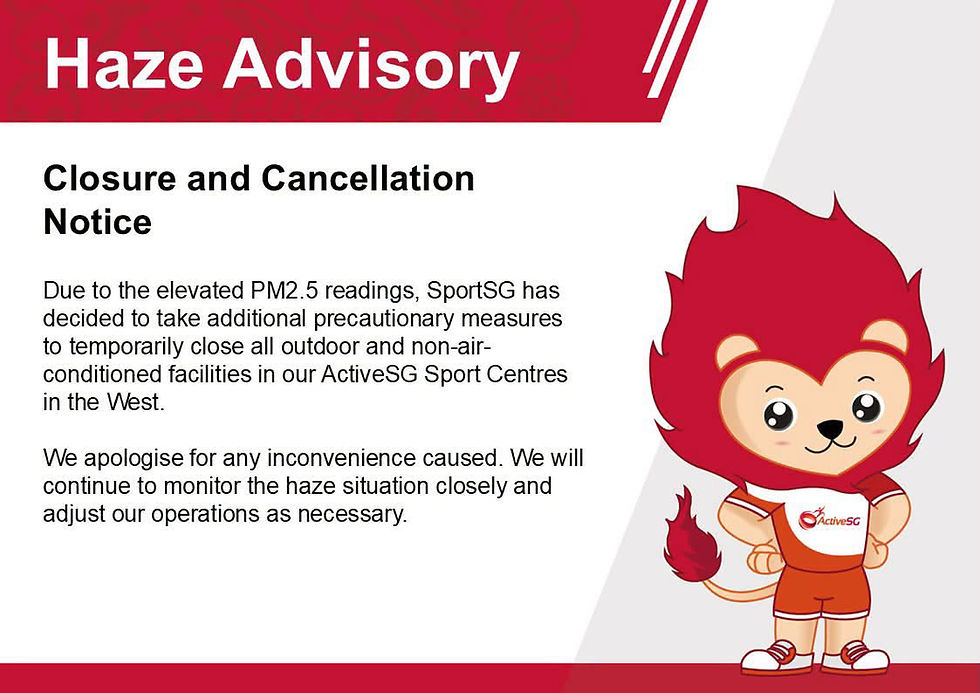
Follow the venue. Sport Singapore facilities adjust operations by haze phase: outdoor and non-air-conditioned facilities operate with conditions at 24-hour PSI 101 to 200, close at 201 to 300, and all facilities close above 300. If your venue closes or suspends activities, that settles it.
Think about the pool type. An enclosed, air-conditioned pool is likely a more cautious choice than a fully open one, but ask the venue and do not assume.
Lower the intensity. If a lesson goes ahead on a borderline day, shorter and gentler sessions mean less hard breathing. The official advice focuses on prolonged and strenuous exertion for a reason.
Skip if in doubt. A rescheduled lesson is easy to recover from.
Tell the coach. If your child has asthma, allergies or any breathing concern, let the coach know and keep prescribed medication within reach.
Stay hydrated. The sources suggest drinking plenty of fluids, which may help with a dry or itchy throat.
Support good air at home. Official advice includes keeping doors and windows closed when outdoor air worsens, keeping air-conditioner filters clean and in good working order, and avoiding smoking indoors.
Watch for delayed symptoms. Because effects can appear one to three days later, keep an eye on how you or your child feel after exposure.
On masks: N95 masks are not needed for brief trips between buildings or for indoor use. HealthXchange notes that N95 masks may not fit children well, and that surgical masks do not seal to the face and do not filter fine particles well. Ask your doctor what is appropriate for your child. Nobody can swim in a mask, so for swimmers the key decisions are whether and where to swim, and how hard.
How SG Sink or Swim approaches this
At SG Sink or Swim, we serve the west side of Singapore and teach many young children, who are among the groups official guidance asks us to be most careful with. Here is how I think about the respiratory question.
I follow official information, and I say where it runs out
The NEA, MOH and Sport Singapore give a clear framework for what to do at different PSI levels. Where the guidance does not address swimming pools or lessons specifically, I try to be upfront about that rather than pretend certainty.
I lean towards caution with children
Because the evidence on swimming in haze specifically is thin, and because children are a sensitive group, I take the cautious side on borderline days. A rescheduled lesson costs little. A breathing scare costs a lot.
I treat intensity as something I can control
On days that are not severe but not ideal, I can lower the load: shorter sessions, more rest and a focus on water confidence, floating, kicking and breathing rhythm rather than hard sets. On poor days, we skip.
I want to know about your child's health
If your child has asthma, allergies or other breathing concerns, please tell me, and show me where their medication is kept. I would much rather know in advance.
I keep progress on track through a pause
Our programmes run from Nursery and Level 1 through Level 2, Level 3 and on to SwimSafer Stages 1 to 6, so progress is tied to a clear pathway. If haze interrupts lessons, we can resume from the right point, and parents are not left guessing where their child stands.
If you would like to talk about how we handle haze, or about adjusting lessons for a child with breathing concerns, you are welcome to get in touch through sgsinkorswim.com.
Frequently asked questions
Is swimming in haze more dangerous than other exercise?
I could not find research comparing swimming with other exercise in haze, so I cannot say. What I can say is that the logic behind official advice, that harder breathing in poor air means more exposure, applies to any strenuous exercise.
Can swimming in haze cause asthma?
I cannot tell you that from the sources I read. Haze can trigger symptoms and worsen existing asthma. The MOH FAQ says overseas studies of continuous, multi-year fine-particle exposure have linked it to childhood asthma, while it notes there is no data on the long-term effects of short-term, episodic haze.
Will a few days of swimming in haze cause lasting lung damage?
The sources I read say there is no local or international data on the long-term health impact of short-term, episodic haze exposure, and that long-term effects usually do not occur unless exposure is prolonged and intense over many months or years. I would not claim either harm or safety beyond that.
My child coughed after swimming on a hazy day. Is it the haze?
It might be, or it might be something else, such as swallowing water, nerves, a cold or cold water. Haze effects can also appear one to three days later. If coughing or breathlessness persists or recurs, please see a doctor.
Is it safe for a child with asthma to swim during haze?
Please ask your child's doctor. Official sources say children with asthma may get more severe symptoms and should follow their asthma action plan when the PSI is above 100 and symptoms appear.
Are indoor pools safe during haze?
They may offer less exposure than open outdoor pools, but I could not confirm how pools are classified in official plans, and indoor air depends on ventilation and filtration. Ask the venue.
Should my child wear a mask to the pool?
N95 masks are not needed for brief trips between buildings or for indoor use, and may not fit children well. Ask your doctor.
What PSI is safe for swimming?
There is no official PSI threshold for swimming that I could find. The official guidance is about prolonged or strenuous outdoor exertion at different bands, with more caution for children and people with conditions. Check your venue's decisions and your doctor's advice.
When should I see a doctor?
If your child, or you, develop breathing difficulties or symptoms that persist or are troublesome. People with chronic heart or lung conditions should seek medical attention promptly if they become unwell.
The bottom line
Haze can irritate the airways and worsen existing conditions, and effects can appear one to three days later.
Exercise increases how much air you breathe, so swimming hard in poor air plausibly increases exposure. That is an inference from physiology and from the logic of official advice, not a measured result for swimmers.
Children and people with asthma or other chronic conditions are the groups to be most careful with.
I could not find swimming-specific research, and official sources say the long-term effects of short, episodic haze are not well studied.
Practical steps, such as checking readings, following venue decisions, lowering intensity, telling your coach and skipping when in doubt, are sensible.
For any health concern, ask your doctor.
Haze season passes. A child's swimming journey is long. The best approach is to stay informed, stay cautious and stay in touch with your coach, and to get back into a regular rhythm as soon as the air clears.
At SG Sink or Swim, we teach from a child's first splash through to SwimSafer Stage 6, and keeping swimmers safe is always part of that job. If you have questions about lessons during haze, reach out at sgsinkorswim.com.
Stay safe, breathe easy, and see you at the pool.
Coach Tan Meng Chew (MC) SG Sink or Swim | sgsinkorswim.com
Comments