

Will Missing Swimming Lessons During Haze Affect Your Child's Progress?

By Coach Tan Meng Chew (MC), SG Sink or Swim
The air is grey, the PSI is climbing, and the venue has just sent a message: lessons are cancelled this week. You are relieved that your child is not breathing hard in poor air. And then, a few minutes later, the second thought arrives: "But what about their progress? Will they go backwards if they miss lessons?"
I hear this from parents every haze season, and I understand it. You have invested money, effort and weekly logistics in getting your child to swim, and you can see them finally getting comfortable in the water. The idea of losing that momentum is stressful.
I'm Coach Tan Meng Chew, known to most people as MC. I run SG Sink or Swim, a swimming school and coaching brand serving the west side of Singapore, teaching from Nursery and Level 1 (Baby & Toddler) through to SwimSafer Stages 1 to 6. This article gives you an honest answer: what usually happens when a child misses lessons during haze, what the evidence does and does not tell us, which situations deserve more concern, and what you can do to protect your child's progress while the air clears.
The short answer
For most children, missing a few lessons during haze will not seriously damage their progress. Long gaps are a different matter, and the way you handle the break makes a real difference.
Here is the more detailed version:
One or two missed lessons are rarely a problem. A good coach can pick up where things left off.
A few weeks away may mean some rustiness, especially for younger children and for skills that are new and still shaky. This is usually recoverable, and a lesson or two of review often gets things back on track.
Months without any swimming are where real loss is more likely, particularly for children who are still building their foundations.
What you do during the break matters. Light, safe practice and a clear plan to resume can make a big difference.
Your child's health comes first. A rescheduled lesson costs you a little time. Pushing a child to swim in poor air, or while unwell, can cost much more.
Let me explain why, and where the limits of what I can tell you lie.
First, a reminder of why lessons get cancelled
It helps to remember why lessons pause during haze at all, because it puts the "missed progress" worry in perspective.
Official Singapore guidance asks for more caution with children as haze worsens. The National Environment Agency's activity advice for haze groups children with the elderly and pregnant women, and recommends that they minimise prolonged or strenuous outdoor physical exertion when the 24-hour PSI is in the Unhealthy range (101 to 200), and minimise outdoor activity in the Very unhealthy range (201 to 300). (The text of the NEA file I read came out jumbled when extracted, so I mapped its table by order. Please verify it on haze.gov.sg.) The Ministry of Health notes that the health impact depends on health status, the PSI level, and how long and how intensely a person is active outdoors, and it names children among the groups to watch.
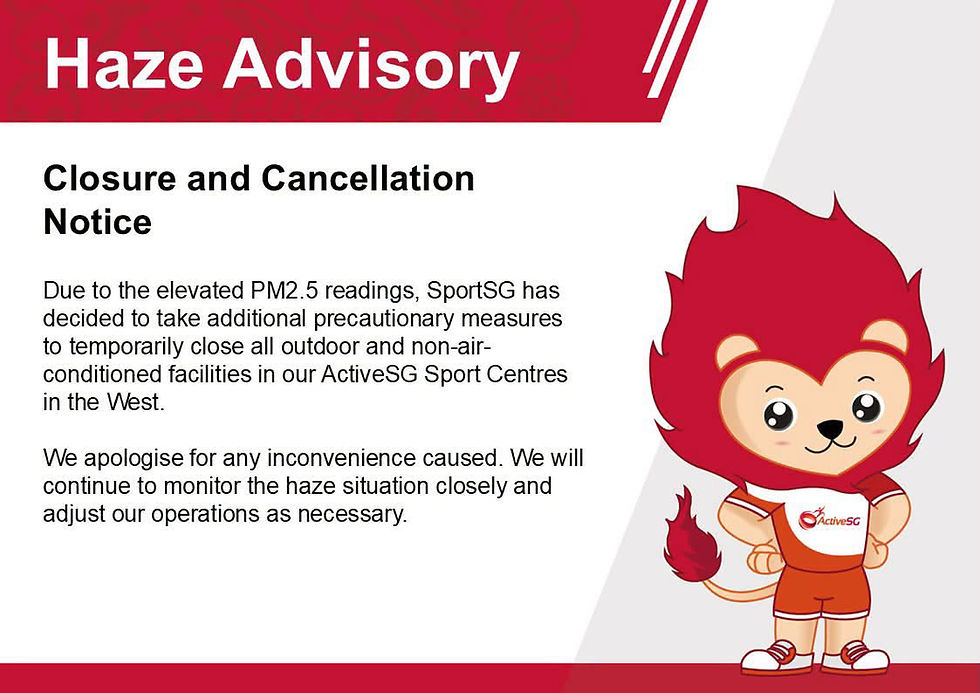
Sport Singapore's Haze Management Plan (April 2026) adjusts facilities by phase: outdoor and non-air-conditioned facilities operate with conditions at 24-hour PSI 101 to 200, close at 201 to 300, and all facilities close above 300. The plan, as I read it, does not say how swimming pools are classified, so your venue's own notices decide.
In other words, when a lesson is cancelled for haze, it is usually because the people responsible for facilities and health are being deliberately careful with children's lungs. That is a good reason to skip, and a few skipped lessons are a small price.
How swimming skills actually behave over a break
Let me explain how I think about skill and breaks, based on years of coaching. I want to be clear that this is coaching experience and general reasoning, not a measured scientific rule I can quote to you in weeks and percentages.
Skills are not all equally fragile
Swimming is not one skill. It is a bundle, and different parts of the bundle behave differently when your child has been out of the water.
Comfort and confidence are usually the most visible casualty of a break. A child who was just starting to put their face in the water willingly may be hesitant again after a few weeks away. This is not a loss of ability so much as a loss of familiarity, and it often returns quickly with a gentle re-introduction.
Newly learned skills that are not yet automatic tend to be the most fragile. A kick that finally started working, or a breathing pattern that clicked two weeks ago, may need a bit of rebuilding.
Well-established skills tend to hold up better. Something your child has done many times across many lessons is less likely to vanish after a short pause.
Fitness and stamina fade faster than technique. A child may remember how to swim a stroke but tire sooner than before. That comes back with regular practice.
Young children and nervous learners are more sensitive to breaks
Babies, toddlers and pre-schoolers are building comfort and routine as much as technique, and they may need longer to settle back in. Nervous learners, whether children or adults, are also more affected by gaps, because their progress rests on trust and familiarity. For these swimmers, I pay extra attention to how we restart.
Older children with solid foundations usually bounce back faster
A child who has already worked through several SwimSafer stages and has solid technique typically re-adapts quickly after a short break. They have more "stored" skill to draw on.
I want to repeat the caveat: these are general patterns from coaching. Individual children vary, and I cannot promise how your child will respond.
What the evidence does tell us
I looked for research on how swimming skills hold up when lessons stop. I found less than I expected on short breaks, and I would rather tell you that than pretend otherwise. What I did find is a relevant Australian study from Deakin University researchers, in partnership with a leisure operator, called "Swim Lesson Models: Effectiveness and Impact Study."
According to the Deakin media release, the researchers found that:
Most children who learned to swim only through intensive school programs could no longer swim a year later.
Intensive programs, which commonly offer five 45-minute sessions, were important and effective, but children also needed weekly lessons to maintain their skills.
Children who built foundational skills and then did only intensive programs with no weekly lessons tended to plateau or lose the skills they had gained.
The best outcomes came from combining weekly and intensive lessons, and weekly lessons had the greatest impact on early learners.
What does this mean for haze? Please read it carefully, because it is easy to over-read. That study is about an Australian context and about gaps of a year between intensive blocks. It does not say that missing a few weeks of lessons during haze will cause skill loss. What it does support is a more general point: swimming skills are built and kept through ongoing, regular practice, and long periods without any practice put hard-won skills at risk. That is exactly why the sensible response to haze is to plan a return to regular lessons, not to treat a pause as permanent.
The real risk is not the missed lesson, it is the missing plan
Over the years, I have noticed that the biggest threat to a child's progress during haze season is rarely the cancelled lesson itself. It is one of these:
The break that quietly becomes permanent. A few weeks off turn into a month, then the school holidays, then a new term, and the family never quite restarts. By the time they think about swimming again, the habit and the momentum have faded.
The restart without a plan. A child returns after a long gap and the coach, or a new coach, starts from scratch because nobody recorded where the child had reached.
The loss of confidence. A child who was nervous to begin with has a long pause and returns more anxious. Parents then interpret the anxiety as "lack of progress."
The feeling that nothing is happening. One of the main reasons I see students stop lessons is that parents feel there is no visible progress. A haze-related pause can deepen that feeling if nobody is explaining where the child stands.
All four of these are manageable. They come down to having a plan, keeping records and communicating clearly.
How the SwimSafer framework helps
Singapore's SwimSafer 2.0 programme is a useful anchor when you are worried about continuity. According to the official ActiveSG description, it has six progressive stages, each comprising approximately 12 hours of lesson time. Stages 1 and 2 build water confidence, safety and basic techniques. Stages 3 and 4 build stroke technique, deep-water breathing and throw rescues, with a goal of swimming 100 metres using varied strokes. Stages 5 and 6 focus on efficient strokes over 200 to 400 metres and advanced survival skills.
Why does this matter during haze? Because a child's progress is organised into defined stages with defined skills. If your child pauses mid-stage, a coach can look at the stage requirements, check what has been mastered, and resume from exactly the right point. You are not starting over. You are continuing along a clearly marked path.
It also helps to remember that each stage involves a theory quiz and a practical assessment, after which learners can obtain an e-certificate. A haze pause may delay an assessment date, but it does not erase what a child has learned. Ask your provider how assessments are arranged around cancellations.
How to protect your child's progress during a haze pause
Here is the practical part. These are things I recommend to families at SG Sink or Swim when haze interrupts lessons.
1. Keep the long-term picture in mind
A pause of a week or two in a journey that spans many months or years is a small blip. Try not to let a cancelled lesson feel like a crisis, because your child will pick up on your mood.
2. Ask about make-up lessons right away
Find out how your provider handles lessons cancelled for haze. Ask whether there are replacement slots, how long you have to use them, and how to book. A clear answer reduces anxiety.
3. Ask the coach where your child currently stands
Before or soon after a break, ask your coach to tell you what stage your child is working on, which skills are solid and which are still shaky. This makes the restart much smoother, and it gives you a clear picture of what to expect.
4. Keep water familiarity going safely at home
While you wait for lessons to resume, you can keep your child's comfort with water alive without going near a pool in poor air. Bath-time bubble blowing, gentle face-in-the-water play, singing water songs with toddlers and practising kicking movements on a bed or sofa with a story can all help. Always supervise children around any water, even a small amount in the bath.
5. Do not pressure your child to catch up
If your child returns feeling rusty or nervous, resist the urge to compare them with earlier lessons. A calm, supportive restart usually gets them back on track faster than pressure.
6. Resume regular lessons as soon as it is safe
Consistency is what keeps skills in place. Once the venue is open and conditions are fine, get back into your regular slot. The sooner the rhythm returns, the sooner the rustiness fades.
7. Consider a short top-up on return
After a longer break, a lesson or two focused on review can help. Ask your coach whether your child would benefit from a gentler first session or a short block of extra lessons.
8. Keep an eye on your child's health
Official sources note that health effects of haze can lag exposure by one to three days. If your child seems unwell, wait until they are better before returning to the pool, and see a doctor for repeated or worrying symptoms.
What about swimming anyway, to avoid missing lessons?
This is the tempting alternative: go to the pool regardless, so nothing is lost. I would urge caution.
On Unhealthy days, official guidance asks for children to minimise prolonged or strenuous outdoor physical exertion. For children with chronic lung or heart conditions, such as asthma, it is more cautious still, and the Ministry of Health advises anyone who is unwell to seek medical attention. If the venue is closed or suspends activities, there is no lesson to attend. If it is open and conditions are borderline, an adjusted, gentler session may be reasonable for a healthy child, and I have written about that decision in other articles. But a skipped lesson is a small, recoverable cost, and a child in respiratory distress is not.
My rule is simple: never trade a child's breathing for a lesson. Progress can be rebuilt. A scare cannot be undone.
When a break deserves more attention
Most haze-related pauses are short and recoverable. A few situations deserve more thought:
A long haze season with many cancellations. If cancellations stack up across several weeks, talk to your coach about a restart plan, and consider extra lessons or a short intensive block afterwards. The Deakin research suggests that the best outcomes come from combining regular weekly lessons with more intensive blocks, so a top-up block after a long pause is consistent with that idea, though I would not claim it as a haze-specific finding.
Very young learners. Toddlers and pre-schoolers rely on routine and familiarity. After a long break, expect a slower re-entry and plan for a gentle restart.
Children about to take a SwimSafer assessment. If an assessment date is close, ask your provider about rescheduling and about a review lesson beforehand.
Children who were just starting to make a breakthrough. A pause at a delicate moment, such as just before a child becomes comfortable with face-in-water or floating, can feel more disruptive. Extra reassurance on return helps.
Children with breathing conditions. For these children, haze may affect not only lessons but also general activity. Follow your child's doctor's advice on when it is appropriate to return to the pool.
How SG Sink or Swim handles haze interruptions
Let me explain how I think about this at SG Sink or Swim. We serve the west side of Singapore and teach many young children, who are the group official guidance asks us to be most careful with. Haze interruptions are part of life here, so I try to make them as painless as possible.
Safety first, then progress
If a venue closes or conditions are poor, lessons pause. I would always rather reschedule than push a child through difficult air.
Progress records that survive a pause
Our curriculum runs from Nursery and Level 1 (Baby & Toddler), through Level 2 (Beginner) and Level 3 (Intermediate), and on to SwimSafer Stages 1 to 6. Because each swimmer's progress is tied to this pathway, a break does not leave anyone guessing about where to restart. The coach can see what has been covered and resume from the right point.
A gentle restart
After a longer pause, I prefer to ease children back in. The first lesson back is often about rebuilding comfort and confidence, then gradually returning to the skills they were working on.
Honest communication
I tell families early when a lesson needs to change and talk through make-up arrangements, so nobody is left wondering. I also give a straight answer when parents ask how a break has affected their child, rather than reassuring them without looking carefully.
Keeping students from drifting away
One of the main reasons students leave swim schools is that parents feel there is no progress, and another is that children feel they can already swim and stop. A haze pause is a moment when families can drift away. So I focus on making the way back easy, with a clear plan, visible next steps and no guilt about the gap.
If you would like to talk about how we handle haze interruptions, or what a restart plan could look like for your child, you are welcome to get in touch through sgsinkorswim.com.
Frequently asked questions
Will my child forget how to swim if we miss a few weeks?
It is unlikely that they will forget everything. Comfort, confidence, fitness and newly learned skills may be a little rusty, while well-established skills usually hold up better. Young children and nervous learners may need more time to settle back in. A short review at the start of the first lesson back is usually enough for a short break.
How many lessons can my child miss before it matters?
There is no magic number, and I do not want to invent one. One or two missed lessons are rarely a problem. Long gaps are where the risk grows, and young or nervous learners are more sensitive. The most useful approach is to have a plan to resume.
Does the research say skills fade quickly?
The research I found does not give a rule for short breaks. The Deakin study found that children who relied only on intensive school programs often could no longer swim a year later, and that weekly lessons helped maintain skills. That supports the importance of regular practice, but it does not predict what happens after a few weeks of haze.
Should I take my child swimming anyway to keep up?
Only if the venue is open, conditions are suitable and your child is well. Official guidance asks for more caution with children and with anyone who has a breathing condition. If in doubt, skip and reschedule.
Can I practise at home? Yes, in safe, supervised ways: bubble blowing in the bath, gentle water play, singing, and practising kicking movements on dry land. Always supervise children around water.
Will a haze pause delay my child's SwimSafer stage?
It might delay an assessment date, depending on cancellations and scheduling. It does not erase what your child has learned. Ask your provider how assessments are rescheduled.
My child seems more nervous after a break. Is that normal?
Yes, it is common. A calm, gradual restart with a familiar coach usually helps. If anxiety persists, talk to your coach about adjusting the pace.
Do I lose my lesson fees if haze cancels a class?
That depends on the provider's policy. Ask about make-up arrangements before haze season.
My child coughs after swimming on a hazy day. What should I do?
A single cough can be minor, but persistent coughing, wheezing or breathlessness needs to be taken seriously. Official sources say anyone not feeling well should seek medical attention, and effects can lag exposure by one to three days. Please see a doctor if symptoms continue.
So, will missing lessons during haze affect your child's progress?
Here is the honest summary:
A few missed lessons: usually minor and recoverable, especially for children with established skills.
A longer break: can mean some rustiness in comfort, stamina and newer skills, and more so for young and nervous learners. Plan a gentle restart.
Very long gaps with no swimming at all: carry a real risk of skill loss, which is why returning to regular lessons matters.
The biggest danger: not the missed lesson itself, but a pause that turns permanent, or a restart with no plan.
The priority: your child's health. A rescheduled lesson is a small cost, and progress can be rebuilt.
Haze season passes. Your child's swimming journey is long. The families who come out ahead are the ones who stay calm, keep in touch with their coach, keep a little water play going at home, and get back into a regular rhythm as soon as the air clears.
At SG Sink or Swim, we teach from a child's very first splash through to SwimSafer Stage 6, and we are happy to help families plan a smooth return after any interruption. Get in touch at sgsinkorswim.com and tell us where your child is now.
Stay safe, breathe easy, and see you at the pool.
Coach Tan Meng Chew (MC) SG Sink or Swim | sgsinkorswim.com
Comments