

Can Haze Cause Coughing, Wheezing or Breathlessness During Swimming?


By Coach Tan Meng Chew (MC), SG Sink or Swim
Every year, when the haze rolls in over Singapore, my phone fills with the same kind of message from parents and adult students: "My child was coughing a lot at the pool." "I felt tight in the chest halfway through my laps." "Should we still come for lesson today?"
If you have asked yourself a similar question, you are not alone. Swimming is a breathing-intensive activity, and haze affects the air we breathe. It is natural to wonder whether the two should mix.
I'm Coach Tan Meng Chew, known to most people as MC. I run SG Sink or Swim, a swimming school and coaching brand serving the west side of Singapore. I am a swim coach, not a doctor, so I will not diagnose anything in this article. What I can do is explain what the official health agencies say about haze and exercise, describe what I see from the pool deck, and share how I think about safety when the air quality drops. Where the question is medical, I will point you to a doctor.
The short answer
Yes, haze can contribute to coughing, throat irritation and breathing discomfort, and swimmers are not exempt, particularly when the swimming is outdoors or the pool area is not well sealed from outside air. Whether it affects a particular person depends on the haze level, how long and how hard they are exercising, and their own health, especially if they have asthma or another chronic heart or lung condition.
Two other points matter just as much:
Coughing, wheezing and breathlessness during swimming do not always come from haze. There are several other causes, and some of them need medical attention. Do not assume "it must be the haze."
Anyone who feels unwell should stop and seek advice. That applies whatever the PSI reading says.
Let me unpack all of this properly.
What the official sources say about haze and health
I want to ground this article in official Singapore guidance rather than opinion, so here is what the relevant agencies say.
According to the Ministry of Health's haze health advisory page, for healthy people, short-term exposure to haze, over a few days, mainly causes irritation of the eyes, nose and throat, and does not generally cause major problems. The page says the health impact depends on a person's health status, such as pre-existing chronic heart or lung disease, the PSI level, and how long and how intensely a person is active outdoors. It names the elderly, children, and people with chronic heart or lung conditions as groups to watch, and says anyone not feeling well should seek medical attention.
HealthHub adds that in healthy people the irritation "resolves on its own in most cases," and that health effects can lag behind exposure by one to three days. It notes that people with chronic heart or lung disease, such as asthma, COPD or heart failure, can be affected more seriously, and that the activity guidelines single out the elderly, pregnant women and children.
The key point for swimmers is this: exertion matters. The more intensely you breathe, the more air, and whatever is in it, you take in. Sitting at home and swimming laps at full effort are very different in terms of how much air passes through your lungs.
How the PSI bands translate into activity advice
The National Environment Agency (NEA) publishes activity guidelines based on the 24-hour PSI (Pollutant Standards Index). Based on the NEA advisory document on planning outdoor activities during haze, the guidance looks like this. The text of the file I accessed was jumbled when extracted, so I have mapped the table by its order. Please check it against the NEA's haze website, haze.gov.sg, before relying on it.
24-hour PSI | Healthy persons | Elderly, pregnant women, children | Chronic lung or heart disease |
0 to 50 (Good) | Normal activities | Normal activities | Normal activities |
51 to 100 (Moderate) | Normal activities | Normal activities | Normal activities |
101 to 200 (Unhealthy) | Reduce prolonged or strenuous outdoor physical exertion | Minimise prolonged or strenuous outdoor physical exertion | Avoid prolonged or strenuous outdoor physical exertion |
201 to 300 (Very unhealthy) | Avoid prolonged or strenuous outdoor physical exertion | Minimise outdoor activity | Avoid outdoor activity |
Above 300 (Hazardous) | Minimise outdoor activity | Avoid outdoor activity | Avoid outdoor activity |
Notice the word outdoor throughout. The advice is about outdoor exertion. The NEA document does not specifically mention swimming or indoor exercise, and I do not want to put words in its mouth. What it does tell us is that, as haze worsens, the sensible response is to reduce hard breathing in polluted air, and that vulnerable groups should be more cautious at lower PSI levels than healthy adults.
HealthHub also explains that the 24-hour PSI forecast is used for planning, while 1-hour PM2.5 readings are used for immediate decisions about whether to do something at a particular time.
What Sport Singapore does with its facilities
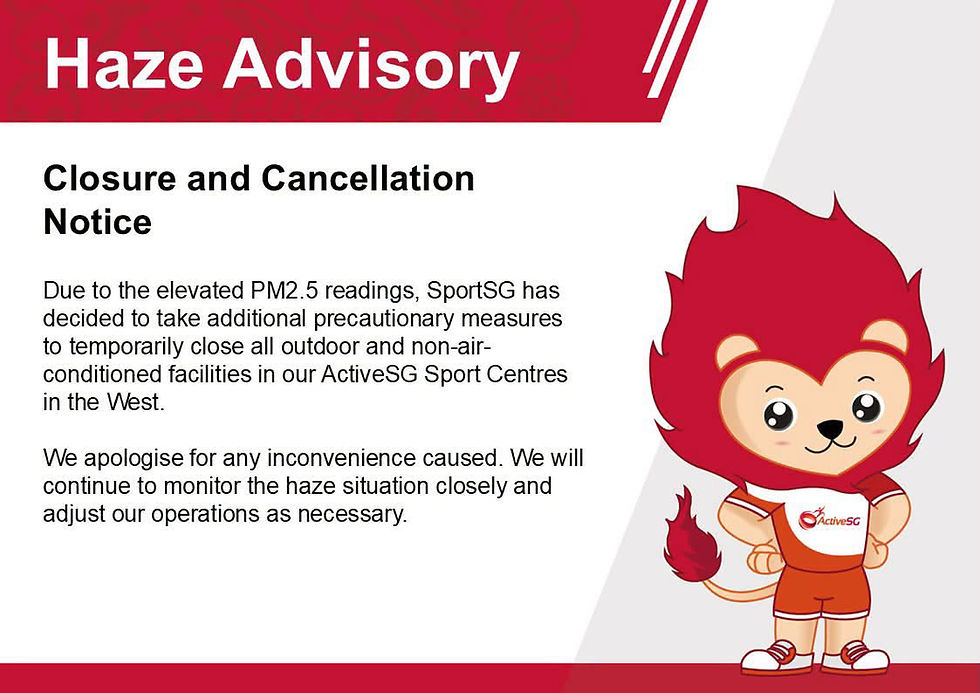
Many Singapore families swim at ActiveSG facilities, so it helps to know how Sport Singapore handles haze. Its haze management page says all ActiveSG sports facilities adjust operating hours and programmes during haze to minimise exposure for staff and guests, with decisions primarily based on the 24-hour PSI forecast and 1-hour PM2.5 readings used as supplementary information for immediate activity decisions.
The SportSG Haze Management Plan (April 2026) organises its response into phases by 24-hour PSI. In summary:
0 to 50: facilities open, activities proceed.
51 to 100: facilities open, with advisories displayed, at-risk staff monitored, N95 masks stocked and ventilation maintained.
101 to 200: outdoor and non-air-conditioned facilities operate with conditions, and organisers must carry out a risk assessment before continuing activities. Anyone feeling unwell must stop and seek medical attention.
201 to 300: outdoor and non-air-conditioned facilities close, and outdoor activities are suspended. Air-conditioned facilities may operate with risk management measures.
Above 300: all facilities close and organised activities are suspended.
One honest caveat: when I read that plan, it did not say how swimming pools are classified, and it did not mention swimming lessons specifically. So I cannot tell you from the document alone how a particular pool would be treated at a particular PSI level. If you are unsure, check the ActiveSG facility notices or ask the venue directly, since operators decide on the day.
Why swimmers might cough, wheeze or feel breathless in haze
Let me explain, in plain terms, why haze could plausibly affect someone in or around the water. I am explaining mechanisms I have seen described by health agencies and general medical sources, not diagnosing anyone.
Haze particles irritate the airways. Haze contains very fine particles that can irritate the eyes, nose and throat. In a sensitive airway, irritation can show up as coughing, a scratchy throat or a feeling of tightness.
Swimming involves heavy, deliberate breathing. During a hard set, a swimmer breathes deeply and often, frequently through the mouth. Mouth breathing bypasses some of the nose's natural filtering, so more of whatever is in the air reaches the throat and lungs.
Outdoor pools expose you directly. At an outdoor pool, you are breathing outdoor air throughout your lesson. At a pool hall with walls and a roof, the air may be somewhat different, though I would not assume an indoor pool is automatically unaffected, since air quality inside depends on ventilation and the building.
People with asthma or other conditions may react sooner. The official sources are clear that people with chronic heart or lung disease can be affected more seriously. For someone with asthma, a poor-air-quality day can be a trigger.
Lag effects. HealthHub notes that health effects can lag exposure by one to three days. That means a child could cough on a clear day after a hazy one, and parents sometimes do not connect the two.
But haze is not the only cause
Here is where I want to be careful. Over years of coaching I have seen many swimmers cough, wheeze or get breathless in the pool for reasons that have nothing to do with haze. Some are harmless; some are not. Common possibilities include:
Water going down the wrong way. Especially for beginners, a mouthful of water triggers a coughing fit. It usually settles quickly.
Poor breathing technique. Holding the breath underwater and then gasping, or breathing out too late, makes a swimmer feel breathless even when their lungs are fine.
Nerves and anxiety. A nervous child, or an adult with a fear of water, may breathe fast and shallowly. That can feel like breathlessness.
Cold water or cold air. Some people cough or feel chest tightness when they get cold.
Colds, coughs and other infections. A swimmer who is already unwell may cough more during exertion.
Pool chemicals and air quality around the pool. Some people find the air around a pool irritating. If someone consistently coughs at the pool regardless of the haze, that is worth mentioning to a doctor.
Asthma or exercise-related breathing difficulty. Some people experience wheezing or chest tightness with exercise. This should be assessed by a doctor, not guessed at by a coach.
Heart or other medical conditions. Persistent breathlessness out of proportion to effort needs medical evaluation.
The practical lesson is that a pattern is more informative than a single episode. If a child coughs once after swallowing water, that is ordinary swimming life. If a swimmer repeatedly wheezes, struggles for breath, or has to stop during activities they could previously handle, it is time to speak to a doctor.
Warning signs: stop and get help
I teach every coach I work with a simple rule: when in doubt, get the swimmer out of the water. A lesson can always be rescheduled. A breathing problem cannot be waved away.
Stop the activity and have the swimmer rest and be assessed if you notice:
Persistent or worsening coughing that does not settle with rest.
Wheezing, which is a whistling sound when breathing.
Difficulty speaking in full sentences because of breathlessness.
Chest tightness or chest pain.
Unusual paleness, blue-ish lips, dizziness or faintness.
A swimmer who looks distressed, panicked or unable to catch their breath.
The Ministry of Health's advice is that anyone not feeling well should seek medical attention, and that people with chronic heart or lung conditions should keep their medications on hand. If a swimmer has been prescribed medication by their doctor for a breathing condition, follow the doctor's instructions on its use, and make sure the coach knows where it is. In an emergency, such as severe breathing difficulty, call for emergency help immediately.
Who should be extra cautious?
Based on the official guidance, the people who warrant the most care are:
Children. The NEA guidelines place children in a more cautious category than healthy adults.
The elderly. Same category, with a more cautious approach.
Pregnant women. HealthHub lists pregnant women among those the guidelines single out.
People with asthma, COPD, heart failure or other chronic heart or lung conditions. These individuals are advised to be the most cautious, and to seek medical attention if they develop symptoms.
Anyone already unwell. A swimmer with a cold, cough or fever should not push through a hard session, haze or no haze.
If you are in one of these groups, or you are the parent of such a swimmer, speak with your doctor about what is appropriate for you or your child during haze periods. I can adjust a lesson plan, but I cannot assess your health.
What about masks?
Parents often ask whether swimmers should wear masks. Obviously, no one swims in a mask. But people sometimes wear one on the way to and from the pool. HealthHub's guidance on N95 masks is that healthy people should wear one when the PSI is above 300 and they must be outdoors for several hours, while people with chronic lung or heart disease should wear one when the PSI is above 200. They are not needed for brief trips between home, transport and buildings, nor for indoor use. HealthHub also stresses that the mask must fit properly with no leaks, and that surgical masks do not effectively filter fine particles.
Because the mask question can be tricky, especially for children, a doctor or pharmacist is the right person to advise on whether a mask is appropriate for your family.
How I think about haze and swimming lessons at SG Sink or Swim
Let me explain my own approach. SG Sink or Swim serves the west side of Singapore and teaches from Nursery and Level 1 (Baby & Toddler), through Level 2 (Beginner) and Level 3 (Intermediate), up to SwimSafer Stages 1 to 6. That means I coach many young children, who are among the groups the guidelines ask us to be more careful with. That shapes how I think.
Principle 1: Follow the official information, and check it on the day
Haze conditions can change within hours. The NEA's guidance is that 24-hour PSI forecasts are for planning, while 1-hour PM2.5 readings help with immediate decisions. Before a lesson on a hazy day, I would rather check the latest readings and the venue's own advisories than rely on yesterday's news. Where a facility closes or suspends activities, that decision comes first.
Principle 2: Be more conservative with children and vulnerable swimmers
Because the official guidelines call for more caution with children, the elderly and people with chronic conditions, I take the same stance in my teaching. If the air quality is borderline, I would rather reduce intensity, shorten the session or reschedule than push a young swimmer through a hard set.
Principle 3: Adjust the lesson, not just cancel it
On days when conditions are not severe but not ideal, a lesson does not have to be all-or-nothing. We can lower the intensity, focus on gentle skills such as floating, breathing rhythm and water confidence, and avoid long, strenuous efforts. That keeps a swimmer's progress ticking over without demanding hard breathing.
Principle 4: Listen to the swimmer
If a swimmer says they feel tight, itchy or breathless, I take it seriously. No lesson plan is more important than the person in front of me. Children do not always describe discomfort clearly, so I watch for coughing, laboured breathing, or a sudden reluctance to continue.
Principle 5: Communicate with parents
Parents know their children's medical history better than I do. I encourage families to tell me about asthma, allergies or other breathing-related concerns, and about any medication their child has been prescribed, so I know what to watch for and what to do. Honest communication makes the pool safer.
Principle 6: Keep consistency without sacrificing safety
Regular lessons are the backbone of progress, which is why I care about consistency. But safety comes first. A rescheduled lesson on a bad air day is a small cost compared with a swimmer in distress, and a clear plan for make-up sessions helps families stay on track.
If you would like to talk to us about how we handle lessons during haze, or about adjusting lessons for a swimmer with breathing concerns, you are welcome to get in touch through sgsinkorswim.com.
Practical tips for swimmers and parents during haze
Check the readings before you go. Look at the latest 24-hour PSI and the 1-hour PM2.5 on the official channels, and check whether your venue has issued an advisory.
Know your group. If you or your child fall into a higher-risk category, be more cautious and follow your doctor's advice.
Reduce intensity on borderline days. Lighter, shorter sessions are better than skipping everything or pushing hard.
Warm up and breathe calmly. Easy breathing at the start helps you notice whether anything feels off.
Stay hydrated. The official sources suggest drinking plenty of water during haze.
Keep prescribed medication accessible. If a doctor has prescribed medicine for a breathing condition, bring it and tell the coach where it is.
Tell the coach early. A scratchy throat or tight chest is worth mentioning at the start of a lesson, not after twenty minutes.
Stop if you feel unwell. The advice from health agencies is consistent: anyone who feels unwell should stop and seek medical attention.
Consider indoor air at home. HealthHub suggests closing doors and windows when outdoor air worsens, avoiding smoking indoors, and using wet-cleaning rather than dry dusting. A portable air purifier is also mentioned as an option.
Watch for delayed symptoms. Because effects can lag by one to three days, keep an eye on how you or your child feel in the days after a hazy spell.
See a doctor for recurring symptoms. If coughing, wheezing or breathlessness happens repeatedly during swimming, whether or not there is haze, get it checked.
Frequently asked questions
Is it safe to swim when the haze is bad?
It depends on the haze level, whether the pool is outdoors, and the swimmer's health. Official guidance asks people to reduce, minimise or avoid prolonged or strenuous outdoor exertion as PSI rises, with more caution for children, the elderly, pregnant women and people with chronic heart or lung conditions. The documents I read did not say how swimming pools are treated, so check the venue and follow its advisories.
My child coughs when swimming. Is it the haze?
It might be, but it might not. Swallowing water, nerves, colds, cold water and other causes are all common. If coughing is repeated, persistent or accompanied by wheezing or breathlessness, please see a doctor.
Should my child with asthma swim during haze?
Please ask your child's doctor. Official sources say people with chronic lung conditions can be affected more seriously and should keep medication readily available. A doctor who knows your child's condition can give advice that I cannot.
Are indoor pools safer during haze?
The official documents I read focus on outdoor exertion and do not specifically discuss indoor pools. Sport Singapore's plan treats air-conditioned facilities differently from outdoor or non-air-conditioned facilities, but it does not say how pools are classified. Ask your venue.
Will my lesson be cancelled if the PSI is high?
That depends on the venue's decision. Sport Singapore facilities adjust operations according to haze phases, with closures and suspensions at higher PSI levels. For private lessons at other venues, the operator's policies apply. Ask your provider how haze is handled and how make-up lessons work.
Do I need a mask for swimming lessons?
You cannot swim in a mask, and HealthHub says N95 masks are not needed for brief trips between buildings or for indoor use. It recommends them when PSI is above 300 for healthy people who must be outdoors for several hours, and above 200 for people with chronic lung or heart disease. If you are unsure, ask your doctor.
How long after haze might symptoms appear?
HealthHub says health effects can lag exposure by one to three days, so symptoms may not appear until after the haze has eased.
Can I rely on a coach to tell me if it is safe?
A coach can follow official advisories, adjust a lesson and watch for warning signs, but a coach is not a medical professional. For health questions, ask your doctor.
So, can haze cause coughing, wheezing or breathlessness during swimming?
Yes, it can contribute, especially for children and for people with asthma or other chronic heart or lung conditions, and especially when the swimming is outdoors and strenuous. But coughing and breathlessness in the pool have many other causes too, and some of them need a doctor's attention. The sensible approach is:
Check the official PSI and PM2.5 information, and your venue's advisories, before you go.
Be more conservative with children, the elderly, pregnant women and anyone with a breathing or heart condition.
Lower the intensity on borderline days, and skip the session when conditions are poor or the venue closes.
Stop and seek help if breathing becomes difficult, and see a doctor for repeated symptoms.
Tell your coach about any relevant medical history so they can look out for you.
At SG Sink or Swim, my priority is keeping swimmers safe first and progressing second. We teach from the very first splash through to SwimSafer Stage 6, and a good swimmer is one who is both skilled and sensible about when to get in the water. If you have questions about your child's lessons during haze, reach out at sgsinkorswim.com.
Stay safe, breathe easy, and I will see you at the pool when the air is clear.
Coach Tan Meng Chew (MC) SG Sink or Swim | sgsinkorswim.com
Comments