

SwimSafer CAMS Theory Quiz: How to Help Your Child Prepare
- SG Sink Or Swim

- Jul 9
- 6 min read
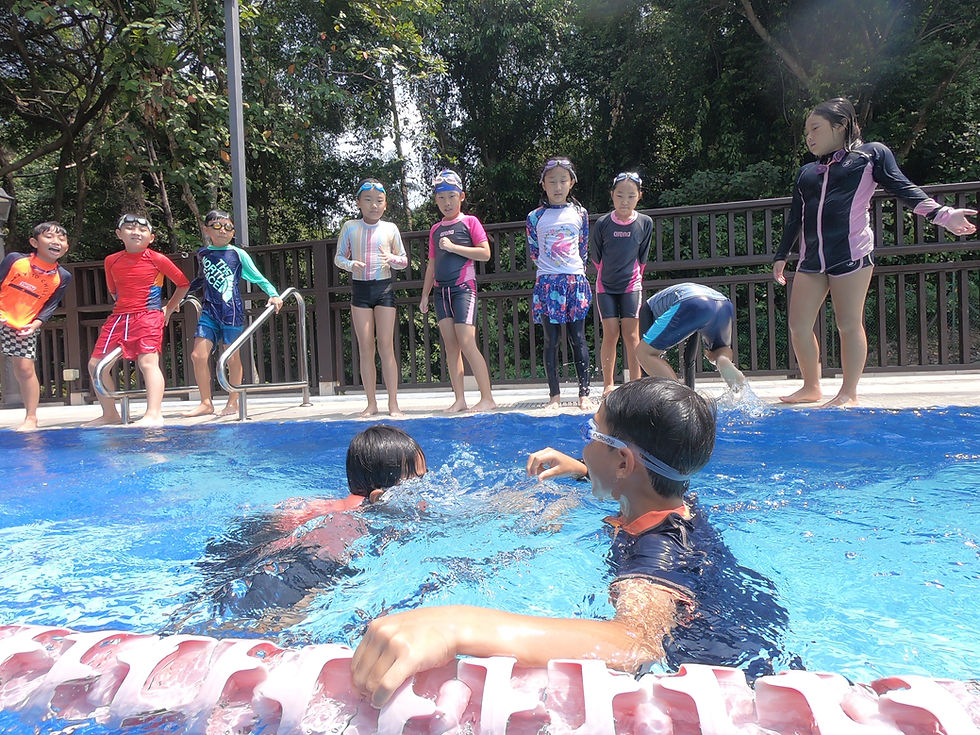
For most Singapore parents, the SwimSafer journey is measured in pool time — lengths swum, floats held, entries mastered. But there's a second hurdle that catches families off guard almost every test season: the online theory quiz. It doesn't involve water at all, yet it's just as capable of derailing a certificate as a failed practical attempt. A child can nail every skill in the pool and still walk away without their stage certificate if the theory component isn't taken seriously.
This guide breaks down what the SwimSafer theory quiz actually tests, why it trips up more families than expected, and how parents can help their child prepare properly — without turning it into another source of test anxiety.
What the SwimSafer Theory Quiz Actually Is
The theory quiz is the knowledge-based half of every SwimSafer 2.0 stage assessment. Since July 2025, it's administered through the Centralised Assessment and Management System (CAMS), the national platform now used for all SwimSafer registrations, practical bookings, results, and certificates. The quiz becomes available on a child's CAMS account once their practical assessment has been recorded, and it must be completed to a 90% pass mark before a certificate can be issued — passing the pool test alone is not enough.
A few operational details matter here, because they catch parents out more than the content of the quiz itself:
The quiz must be completed within seven days of the practical assessment. Missing this window means the practical result is forfeited entirely — your child would need to retake the swim test from scratch, not just the quiz.
A one-time, 30-day extension can be requested on CAMS for a $5 administrative fee, but only if it's applied for before the seven-day deadline lapses. There are no further extensions after that.
Unlike the practical assessment, there's no cap on attempts. A child can retake the quiz as many times as needed until they clear the 90% threshold.
The quiz is only available in English, and it must be completed under the child's own login, with their name entered exactly as registered.
Because the deadline is unforgiving and the content is unfamiliar to most children (and honestly, most parents), treating the theory quiz as an afterthought is the single most common reason certificates get delayed or, in the worst case, forfeited.
Why "Just Theory" Still Needs Real Preparation
It's tempting to assume a multiple-choice quiz about water safety will be intuitive for any child who's spent weeks at the pool. In practice, three things make it harder than expected:
The 90% bar is high. Unlike a typical school quiz where 60–70% might be a comfortable pass, SwimSafer's threshold leaves very little room for guessing. A handful of unfamiliar terms or scenario-based questions can be the difference between pass and fail.
The questions test judgment, not just facts. Many items describe a scenario — a child invited to swim unsupervised, a family considering swimming during a thunderstorm, someone deciding how to enter a pool safely — and ask what the correct course of action is. This requires the child to apply safety principles, not just recall vocabulary.
Younger children read more slowly under quiz conditions. Even strong swimmers in the Stage 1–2 age range may need help simply parsing the phrasing of a question, independent of whether they know the underlying safety concept.
None of this means the quiz is difficult in an absolute sense — most children who prepare even briefly with a parent pass on the first or second attempt. But "briefly" needs to actually happen; it rarely happens by accident.
Core Knowledge Areas by Stage
The quiz content builds in complexity alongside the practical syllabus. Broadly, each stage's theory questions map onto its practical themes:
Stage | Practical Focus | Theory Quiz Emphasis |
1 | Water confidence, safe entry/exit, floating | Basic pool safety rules, recognising danger signs, who to tell before swimming |
2 | Sculling, surface dives, deep-end awareness | Safe entry methods, dangers of unsupervised swimming, general pool etiquette |
3 | Stroke refinement, elementary rescue awareness | Open-water hazards, weather conditions unsafe for swimming, basic rescue judgment |
4 | Intermediate survival, longer-distance strokes | Recognising open-water dangers (rip currents, waves, watercraft), PFD basics |
5 (Silver) | Diving fundamentals, sinking-boat scenario, distress signalling | PFD fitting and use, distress signals, judgment under simulated emergency scenarios |
6 (Gold) | 400m stroke proficiency, HELP technique, life jacket use in water | Comprehensive survival knowledge, life jacket procedures, cold-water survival posture (HELP) |
A consistent thread runs through all six stages regardless of level: personal safety and survival principles, environmental awareness, health awareness, and how to respond in emergency situations. These four themes, which SportSG and Singapore Aquatics describe as the backbone of the water safety knowledge component, reappear in some form at every stage — they simply get more nuanced as children progress.
Practical Ways to Help Your Child Prepare
1. Read the material together before attempting the quiz cold. CAMS and most swim schools point parents toward a "Water Safety Knowledge" reference before the quiz opens. Sit down with your child and go through it together rather than sending them to attempt the quiz unprepared — treating it as a shared 15–20 minute activity rather than homework makes a real difference in how seriously a child engages with it.
2. Talk through scenarios, not just facts. Rather than drilling isolated definitions, ask "what would you do if…" questions: What would you do if you saw dark clouds while at an outdoor pool? What should you do before accepting an invitation to swim at a friend's condo? This mirrors how the quiz actually presents information and builds the judgment the assessment is checking for, not just memorised answers.
3. Do a practice run using their actual CAMS login. Because the real quiz only opens after the practical assessment, you can't rehearse the live version in advance. What you can do is make sure your child is comfortable navigating a quiz interface — reading a question fully, considering all options, and not rushing to the first plausible answer. This matters more for younger, Stage 1–3 children who are less used to screen-based assessments.
4. Plan for the deadline, not just the content. Preparation isn't only about knowledge — it's about timing. Since the seven-day clock starts from the practical assessment date, decide in advance which day you'll sit down with your child to complete the quiz, ideally within the first one or two days while the test experience (and the coach's pre-test reminders) are still fresh. Waiting until day six leaves no room for a bad day, technical hiccup, or need for a retake.
5. Don't over-coach the answers. It can be tempting to simply tell a child the "correct" answer to memorise. This works for the quiz but undermines the actual point of the programme — which is to reduce real drowning risk. Framing preparation around genuine understanding, even briefly, means the safety knowledge is more likely to stick outside the assessment context too.
Common Mistakes Parents Should Watch For
Mistake | Why It's a Problem | Better Approach |
Leaving the quiz until day 6 or 7 | No buffer if a retake or technical issue is needed | Attempt within 1–2 days of the practical |
Assuming a strong swimmer will "just know" the answers | The 90% bar leaves little room for guessing on unfamiliar scenario questions | Spend even 15–20 minutes reviewing water safety material together |
Letting the child attempt the quiz on their own device with wrong login details | Mismatched NRIC/name details can cause results not to register correctly | Double-check the child's name, NRIC/FIN and login are entered exactly as registered |
Not requesting the extension before the deadline | Extensions cannot be requested retroactively once the 7-day window has lapsed | Apply for the one-time 30-day extension early if a delay looks likely |
Treating the quiz as a formality after passing the pool test | Certificates require both components to pass — the practical result alone is not enough | Treat the theory quiz with the same seriousness as the pool assessment |
Final Thoughts
The SwimSafer theory quiz is a small, deliberately low-friction step compared to the physical demands of the practical assessment — but it carries real consequences if it's ignored or left too late. A 90% pass mark, a firm seven-day deadline, and scenario-based questions mean that even confident swimmers benefit from a short, focused preparation session with a parent. The good news is that this doesn't need to be stressful: fifteen to twenty minutes of talking through real-world water safety scenarios, done within a day or two of the practical test, is usually enough for most children to clear the quiz comfortably on their first or second attempt. Treated this way, the theory quiz stops being an administrative afterthought and becomes what it was actually designed to be — a genuine reinforcement of the water safety habits that keep children safe long after the certificate is issued.


Comments