

SwimSafer Stages 1–6 Explained: A Parent’s Complete Guide

Executive Summary: SwimSafer is Singapore’s national water-safety certification program, comprising six progressive stages that teach children to swim and survive in water safely. Developed by Sport Singapore, SwimSafer 2.0 emphasizes both swim strokes and personal survival skills. Each stage builds on the last, gradually increasing distance, technique, and rescue knowledge. Stage 1 is an introduction for confident water beginners (recommended age 6+, though some schools take younger children) and leads up to Stage 6 (Gold), where a child must swim 400 m total and demonstrate advanced rescue readiness. This guide explains each stage – who it’s for, objectives, skills taught, and assessment criteria – plus typical lesson progression, common parental concerns and mistakes, practice tips and drills, expected timelines, and handy checklists. A summary table compares key skills across stages, and we include a suggested weekly practice plan and assessment checklist for parents.
Overview: What Is SwimSafer?
SwimSafer is a national water-safety program introduced in 2010 by Sport Singapore in collaboration with the National Water Safety Council. It replaced older swimming programs (LTSP/NASSA) to create a single progressive framework focused on drowning prevention. The program has six stages (sometimes called “Bronze, Silver, Gold” for Stages 4–6) and is part of Singapore’s SwimSingapore learn-to-swim framework. Each stage of SwimSafer combines swim technique, water safety knowledge, and personal survival skills. By completing SwimSafer, children gain nationally-recognized certification that demonstrates their ability to swim safely in a variety of conditions.
Progression: Six levels from Stage 1 (water familiarization) to Stage 6 (advanced proficiency).
Time: Each stage typically takes 12–20 lessons (roughly 3–5 months at 1×/week). With twice-weekly lessons, some children progress faster.
Assessment: At each stage, children must pass a practical swim test (under the SwimSafer CAMS system) and an online theory quiz (90% pass mark). Successful completion earns a national certificate (Stage 1–3 certificates; Bronze, Silver, Gold for 4–6) valid at Singapore pools.
SwimSafer lessons are delivered by certified instructors at SportSG pools or private schools. The focus throughout is on safety: teaching children to enter/exit water safely, float, call for help, and recognize hazards before mastering strokes. Stage 1–3 lay the foundation (introduce strokes and basic survival), while Stages 4–6 refine strokes over longer distances and add advanced rescue skills.
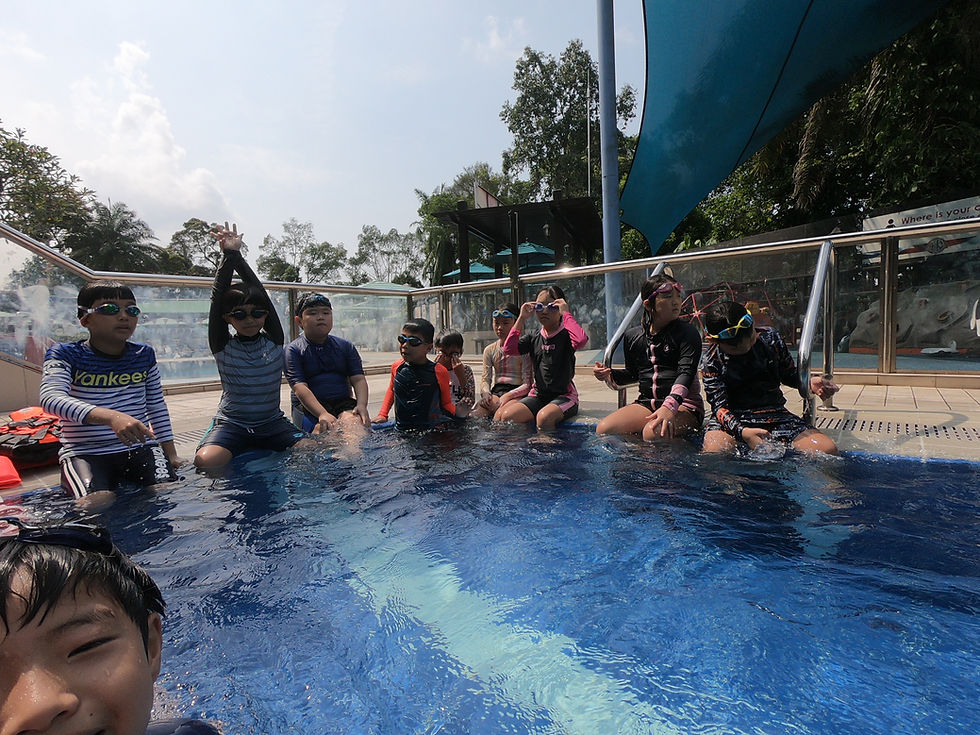
Figure: Young swimmers practicing kickboard drills in class. SwimSafer Stage 1–2 emphasizes comfort and basic skills in the water.
Stage 1: Introduction to Water Skills
Age/Entry: Recommended for beginner swimmers, typically 6 years and older (some schools may accept 5-year-olds in introductory classes). No prior swimming ability is required – this is for children who may be new or very nervous in the water. Stage 1 aims to build confidence, water comfort, and fundamental safety awareness.
Learning Objectives & Skills: At Stage 1, the goal is not perfect technique but water familiarization and independence. Key skills include:
Safe pool entry/exit: entering via steps/slide-in or ladder, and climbing out unaided.
Breath control: putting face in water and blowing bubbles through mouth and nose.
Head-up swimming: moving on front and back for 5–10 meters comfortably.
Floating: front and back floats (with support initially), gliding 5 s or more.
Body position: introduction to kicking and basic arm sculling movements.
Personal survival: calling for help (signaling distress) and grasping a floatation aid, plus an intro to PFD (life jacket) use on land.
Officially, Stage 1 teaches “forward and backward movement, entering/exiting safely, and introduction to survival skills”. SG Sink Or Swim (a reputable swim school) likewise notes Stage 1 covers pool safety, recovering after falls, basic freestyle and breaststroke kicks/arms, floating and gliding. Safety awareness concepts (pool depth, supervision) are also introduced in age-appropriate ways.
Assessment Criteria (Test Requirements): To pass Stage 1, a child must demonstrate key tasks in one continuous sequence (no goggles). These include (for example):
Slide-in pool entry, submerge and open eyes to pick an object from the bottom.
Swim 5 m on back (any combination of arm/leg).
Front and back floats for 5 s each, standing up after each.
Swim 10 m on front (any stroke), then signal and call for help.
Grasp a floatation device, float 10 s, swim with it to the pool edge, and exit safely.
(Stage 1B) In clothing, fit a PFD, jump into deep water, float 30 s, and climb out via ladder.
(The full SwimSafer handbook specifies similar milestones: e.g. “10 m on front, 5 m on back; 5-sec float”). The emphasis in the Stage 1 assessment is on safe performance of these fundamentals – little effort is made on stroke quality.
Typical Lesson Progression: Beginners usually start in chest-deep water. Early lessons focus on getting wet (face-into-water games, bubble blowing) and mastering entry/exit. Soon they learn front-back floats and kicking with support. As confidence grows, instructors introduce arm movements, glides, and short unassisted swims. A typical 12–16 lesson course at 1×/week can cover all Stage 1 skills. Progression is individual: fearful children may spend more time on floats and confidence games, while eager kids may move quickly to kicking and short front/back swims.
Common Concerns & Mistakes: A frequent parent worry is water fear or reluctance. Stage 1 children often resist submerging or may panic if forced. Pushy teaching or comparing with peers can backfire. Other pitfalls include expecting mastery too fast – Stage 1 is about comfort, so parents should not pressure for perfect stroke. It’s also common for kids to “forget” to breathe (holding breath) when tired. Encouraging, patient instruction is key. Parents sometimes get anxious themselves; staying calm and supportive (rather than showing fear) helps build the child’s confidence. Finally, children at this stage often mistake treading for simply kicking – remind them to use both arms and legs for stability.
Practice Tips & Drills (at Home or Lessons): Parents can reinforce Stage 1 skills outside class:
Bubble-blowing game: At home or in shallow water, have the child blow bubbles through a straw or nose to practice breath control.
Treading on land: Have the child lie on their belly and kick with straight legs to build leg strength.
Arm drills: Practice arm sweeps on dry land by lying face down on a carpet, sweeping arms outward and backward.
Jumps: Build pool-entry confidence by jumping off low steps or the edge into an adult’s arms on land, then replicating in shallow water.
Floats: At home, support the child on a carpet or sofa and practice leaning back into a float. This builds the muscle memory for back float.
Blow and hold: In the bath, have the child blow bubbles, then hold breath and count to 5 before emerging.
Expected Timeline: Most children complete Stage 1 in about 2–3 months of weekly lessons. (With twice-weekly lessons, it may be as quick as 4–6 weeks.) However, progression varies widely: confident, swim-regular kids may zip through, while more cautious ones may take longer. Patience is important – a solid foundation in Stage 1 pays off later.
SwimSafer Stage 1 – SG Sink Or Swim offers more details on the Stage 1 syllabus, practice sequences, and local class offerings.
Stage 2: Fundamental Water Skills
Age/Entry: Entry to Stage 2 requires completion of Stage 1 (or equivalent skills) – typically after a successful Stage 1 assessment. Recommended age is usually 7+, though there is no strict age cutoff. Children should already be comfortable unassisted in shallow water and able to float independently.
Learning Objectives & Skills: Stage 2 (often called the Bronze level in some centers) builds on Stage 1 by developing stroke technique and independence in deeper water. According to SportSG, Stage 2 includes “sculling, feet-first surface dives, personal water safety skills, and awareness,” with encouragement to swim 25 m continuously. In practice, typical skills taught include:
Swimming 25 m continuously: usually a combination of front crawl and backstroke without stops. This establishes endurance.
Intermediate strokes: Proper freestyle arm pulls with side breathing, and alternating-leg/backstroke 15–25 m.. (Sidestroke is sometimes introduced as a survival stroke.)
Treading water (30 s+): Learning to stay afloat in deep water using arms and legs.
Submerged skills: Feet-first surface dives (to pick up objects) in chest-deep water.
Entries: Forward dive or step-in entries (from poolside, at least 1.2 m deep).
Rollovers: Front-to-back and back-to-front rolls/glides as transitions.
Water safety & rescue: Identifying hazards, and basic rescue assists: e.g., practicing throw-and-reach (tossing float to a “victim”). Stage 2 also emphasizes behavioral skills like swimming in pairs, waiting for turn, and calling for help when needed.
SG Sink Or Swim’s Stage 2 page notes learning “backstroke and sidestroke, extended treading, diving and forward-roll entry, and reaching/throwing rescue techniques,” with strong emphasis on water-safety behavior. These mirror the national curriculum’s focus on swimming 25m continuously and developing all-round aquatic skills.
Assessment Criteria: The Stage 2 practical test consists of a swim plus two sequences (no goggles). Key requirements include:
Swimming: 25 m swim on front (any stroke) plus 15 m on back.
Sequence 2A (poolside start): Step into water, front float 10 s, swim 5 m and roll to back float 10 s, then 5 m back swim, scull/float/tread 30 s, recover an object from chest-deep water, and exit.
Sequence 2B (with clothes): Wear a t-shirt and shorts, swim 15 m any survival stroke (face above water) and exit, then fit a life jacket (PFD), jump into ≥1.4 m water, swim 25 m wearing the PFD, and climb out..
In sum, the child must show they can swim medium distances without aids, float/tread at depth, dive for objects, and use a PFD – all with safety and composure. Passing Stage 2 requires demonstrating these skills in sequence, meeting the distance/time requirements.
Typical Lesson Progression: In Stage 2 lessons, instructors refine stroke mechanics and increase practice depth. Early sessions focus on building 25 m endurance (often broken into 10–15 m segments with rests). Breathing drills (side breathing, timed exhalation) are emphasized. By mid-level lessons, children practice diving for toys, doing somersaults, and treading for longer. Instruction in safe entries (dives and jumps) and handling PFDs begins. Many swim schools cover the Stage 2 syllabus over 15–20 lessons (3–4 months at 1×/week), but individual pace may vary.
Common Concerns & Mistakes: At this stage, parents often worry about their child’s endurance and breathing. Struggling to breathe bilaterally or swallowing water during freestyle is common. Encourage slow, rhythmic breathing; inhaling above water and exhaling in. Children may also resist diving or feel anxious about deep water. Gradual exposure (scuba goggles underwater in a small pool, stepping into deeper water slowly) helps. Another frequent issue is poor body position – kids sometimes let hips sink in freestyle. Parents can remind children to kick from the hips and keep a straight line. Finally, ensure children understand treading: simply kicking is not enough – they should kick and scull with arms to stay afloat.
Practice Tips & Drills: To reinforce Stage 2, parents can use pool time or dry-land drills:
Kickboard swims: Have the child kick 25 m front crawl or backstroke with a kickboard to build leg strength and endurance.
Shallow dives: In a shallow area, practice bending knees and doing feet-first entries or shallow jumps to improve dive comfort.
Object retrieval: Toss dive toys in a safe corner and have the child do feet-first dives to pick them up.
Rolling glides: From a float position, practice flipping between front and back floats with minimal push-offs.
Tread practice: In deep water with lifejackets, let the child tread in pairs or with partner games for 30+ seconds.
PFD games: Play “wearing a life jacket race” across a shallow pool to simulate Stage 2B.
Expected Timeline: Children typically require 3–5 months to meet Stage 2 standards. (SinkOrSwim estimates ~15–20 lessons.) Progress depends on consistency – twice-weekly lessons can accelerate results. By the end, a child should swim 25 m comfortably and tread for at least 30 s.
SwimSafer Stage 2 – SG Sink Or Swim provides details of the Stage 2 syllabus and sequences for reference.
Stage 3: Personal Water Survival and Stroke Development
Age/Entry: Stage 3 is for students who have passed Stage 2 (or equivalent skills). The child should already swim 25 m unassisted and tread water reliably. This stage is often taken by 7–9 year-olds, depending on the child’s ability.
Learning Objectives & Skills: Stage 3 focuses on introducing all four competitive strokes and enhancing survival skills. SportSG describes Stage 3 as teaching “personal water survival and basic rescue skills”, with proficiency in sculling, underwater skills, and PFD use. A 50 m continuous swim is expected. Typical curriculum includes:
Strokes: Swimming 50 m total with proper technique. This generally means 25 m freestyle with efficient breathing and 25 m backstroke with alternating arms. Stage 3 also introduces 25 m breaststroke in sequence, often after the 50 m swim. (Butterfly may be touched on, but isn’t required until Stage 6.)
Distance swim: The continuous 50 m swim tests endurance; children must pace themselves and maintain form.
Survival strokes: Learning “survival backstroke” (arms extended sculling on back) and other non-standard strokes to stay afloat with minimal effort.
Dives and entries: Stride or compact jumps from ≥1.2 m, plus head-first dives (especially for Silver Stage).
Sculling: Hand sculling drills on back and front to refine propulsion and balance.
Underwater skills: Swimming through hoops or under a short distance to practice breath control.
Rescue skills: Advanced assisting – e.g. swimming to a PFD, fitting it while treading, and towing a (rescue) PFD or person. Stage 3 reinforces throw/throw techniques and rescue with floats.
Safety knowledge: Recognizing hazards, and understanding that swimming should only be done with supervision or designated areas.
SG Sink Or Swim Stage 3 notes emphasize advanced strokes (front crawl, breaststroke) and complex survival strokes, along with long-distance swimming. This is in line with the national Stage 3 goals: all four strokes introduced and swimming 50 m.
Assessment Criteria: The practical test for Stage 3 again has a continuous swim and two sequences. Key elements:
Swim: 50 m total – typically 25 m front crawl + 25 m backstroke continuously.
Sequence 3A (stride entry): Swim 25 m survival backstroke then 25 m breaststroke, scull 5 m on back, tread 50 s, swim 2 m under hoops on pool floor, resurface, and exit.
Sequence 3B (with clothes): In swimwear/shorts/t-shirt: swim 25 m using survival backstroke or breaststroke to reach a PFD (face clear), then correctly fit the PFD and swim 50 m with it before climbing out.
This means a child must handle longer swims with technique, demonstrate survival stroking and underwater swim, and show they can don a life jacket in water. Emphasis is still on performing all actions calmly and safely.
Typical Lesson Progression: Stage 3 lessons refine stroke mechanics and boost endurance. Early sessions practice 25 m of each stroke with coaching on breathing and body roll. The middle portion of Stage 3 often focuses on mastering breaststroke kick and arms. By the end, children do continuous 50 m swims and survival floats. The Stage 3–4 split sometimes varies by school: Stage 3 usually ends at 50 m swimming, while Stage 4 (Bronze) is the 100 m swim. Many programs allocate 20–25 lessons (4–6 months) to cover Stage 3.
Common Concerns & Mistakes: At Stage 3, coordination between arms and breathing can be challenging, especially switching to breaststroke. Common problems include overkick in freestyle (tipping feet up) or dragging knees in breaststroke. Working on timing (arms first, then kick) helps. Fatigue over 50 m may cause stroke deterioration. Encourage steady pacing. Some children resist going underwater; using goggles and fun hoop games can reduce fear. Parents should also be aware Stage 3 often introduces competitive starts and turns; anxiety around racing can appear. Emphasize that the test is just for safety, not a race.
Practice Tips & Drills: To support Stage 3 development:
Endurance swims: Time 50 m backyard swims or laps at public pools, focusing on continuous swimming.
Breaststroke drill: Use a kickboard to practice breast kick separately, or hold arms in streamlined position while practicing the whip kick.
Butterfly kick: Even though not tested yet, practicing the dolphin kick (legs only) on a kickboard can prepare for Stage 4.
Underwater swims: In a safe setting, have the child swim 5–10 m underwater to improve breath control (always with adult supervision).
Sculling floats: In deep water, support the child in back float position and have them move 3–5 m by small arm sculls.
PFD fitting: Play a game of “quickest life-jacket wear” in shallow water to build comfort with the Stage 3B requirement.
Expected Timeline: A motivated swimmer may reach Stage 3 in about 4–6 months (12–20 lessons). Children with prior swimming experience sometimes skip directly into Silver (Stage 5) certification, but mostly students spend 3–5 months per stage. Keep in mind that Stage 3 is a turning point where stroke technique becomes as important as survival skills.
SwimSafer Stage 3 – SG Sink Or Swim describes typical activities and skills for Stage 3.
Stage 4 (Bronze): Water Safety & Stroke Development
Age/Entry: After Stage 3 (or demonstrated equivalent ability), children typically around 9–10 years old enter Stage 4. Completion of the 50 m swim requirement is expected.
Learning Objectives & Skills: Stage 4 (also called Bronze) is an advanced learn-to-swim level focused on solidifying all four strokes and survival techniques over longer distances. Officially, it emphasizes “stroke improvement” and coordinated breathing for 100 m combined swim. Core skills include:
100 m continuous swim: Usually broken into 25 m of backstroke, front crawl, survival backstroke, and breaststroke (in any order), or as a continuous 100 m swim combining strokes.
Stroke refinement: Developing legal stroke technique in all four strokes. Particular focus is on efficient breaststroke kick and simultaneous arm pull. Swimming smoothly with minimal pauses is expected.
Butterfly basics (intro): While only 15 m is required at Stage 6, Stage 4 may introduce 5–10 m of dolphin kick or butterfly drill at surface, often not mandatory but taught for preparation. (Some schools introduce low-level butterfly drills here.)
Treading & floating: Tread water for 2 minutes continuously. Practice often includes sculling/floating transitions.
Deep diving: Feet-first and head-first surface dives to recover objects from at least 1.4 m deep.
Survival strokes: Swim 3 min in clothing using a mix of survival backstroke, sidestroke, survival breaststroke (switching strokes every 15 m).
Somersaults and jumps: Forward somersaults in deep water from a jump, and compact (pike or tuck) jumps from poolside.
Rescue techniques: Reaching and throwing assists in deep water – e.g., wave for help and demonstrate catching a thrown buoyancy aid and returning to safety.
Clothed swim: Swim to and kick with a float, then exit – simulating a rescue or accident scenario.
SG Sink Or Swim’s Stage 4 description similarly lists 100 m swim with all strokes, treading 2 min, surface dives, and clothed swims, emphasizing foundation for the Lifesaving 1 award. Bronze stage reinforces that swimmers have a solid, balanced skill set in the water.
Assessment Criteria: The Stage 4 test requires:
Swim 100 m: 25 m of each stroke (back, crawl, survival back, breast) continuously.
Sequence 4A (deep-water entry): Compact jump into deep water, resurface, do a forward somersault, tread/float 2 min, do a 1.4 m feet-first surface dive, swim 2 m through hoops on pool bottom, then resurface and exit.
Sequence 4B (clothes/rescue): In pants and t-shirt: 3 min slow swim using survival back, sidestroke, survival breast (changing stroke every 15 m), wave/call for help (simulated rescuer throws aid), then swim to the aid, kick to pool edge, and climb out.
These tasks ensure the swimmer can handle extended swims, underwater skills, and basic rescues. Passing Stage 4 shows a child can swim 100 m with proper form and survive longer exposures (clothed).
Typical Lesson Progression: Stage 4 lessons polish technique and focus on conditioning. Early classes emphasize pacing a 100 m swim (often broken into 4×25 m with quick 5–10 s breaks). Coaches work intensively on any stroke flaws (like breast kick timing). Mid-stage covers underwater recovery drills (hoop swims) and rescue practice. Later lessons practice the full assessment sequences in training: deep dives, 2 min treads, and clothed swims for muscular endurance. Many children spend 18–24 sessions (4–6 months) in Bronze before attempting assessment.
Common Concerns & Mistakes: The jump from Stage 3 to Bronze is challenging because breathing and endurance demands increase. Freestyle bilateral breathing (both sides) is expected – some kids default to one-side breathing; teach them gradually to look to the other side every 4–6 strokes. The 100 m swim often causes drifted kicks (feet no longer pointed); parents should encourage continuous kicking practice (flutter kick drills). The clothed swim can be scary – ensure the child practices with lightweight clothing and knows to swim gently rather than panic. A common error is holding breath underwater; reinforce exhaling underwater to avoid buoyancy issues during dives.
Practice Tips & Drills: For Stage 4:
Long swims: Incorporate 50–100 m swim repetitions in practice, timing them to build stamina.
Butterfly kick sets: Even if not required, use a kickboard to practice 5–15 m dolphin kicks (helps core strength).
Surface dives: Use pool toys or coins to drop to 1.4 m depth; have the child dive feet-first to retrieve.
Flotations: Time how long the child can float on back before or after swims (goal: 2 min).
Rescue game: Throw a buoy or noodle to a treading child and practice returning it.
Clothed drills: At home, have the child run around with clothes on or swim in a safe pool with a quick dry-off routine, so the wet weight feels normal.
Expected Timeline: Bronze (Stage 4) often takes 4–6 months of training. Mastering the 100 m swim and 2-min tread are the key milestones. Children usually take slightly longer here than earlier stages due to increased demands. Steady, technique-focused training is more important than rushing to test.
SwimSafer Stage 4 (Bronze) – SG Sink Or Swim outlines the Stage 4 requirements in detail.
Stage 5 (Silver): Intermediate Survival & Stroke Refinement
Age/Entry: After earning Bronze (Stage 4) certification, children typically 10–12 years old proceed to Stage 5. They should swim 100 m well and tread 2 min already.
Learning Objectives & Skills: Silver stage shifts focus toward advanced proficiency and preparedness for emergencies. Children refine all strokes and learn advanced survival/rescue skills. According to SportSG, Stage 5 introduces diving and demands efficient stroke technique. Key components:
Timed swims: Maintain or increase speed over distance. Stage 5 requires timed swims (e.g., 50 m in set times) rather than continuous non-stop swims.
Speed & efficiency: 50 m front crawl in ≤1:30, 50 m breaststroke in ≤1:50, 50 m backstroke in ≤1:40. Technique must be legal and smooth.
Sidestroke and survival: 25 m survival backstroke and 25 m sidestroke (rescue stroke). These strokes help in rescues and conserving energy.
Dolphin kick: 10 m underwater dolphin kick on front. Builds core strength for butterfly.
Deep-water drills: Backward somersault jumps, 1.8 m surface dives with ear equalization.
Obstacle swim: Swim through hoops 3 m deep.
Timed fast swim: Swim 45 m front crawl quickly (as part of sequence).
Help & rescue skills: Demonstrate waving and calling for help, then retrieving a thrown PFD and fitting it while treading. Demonstrate the HELP (Heat Escape Lessening Posture) for 30 seconds. Finally, swim 25 m using the PFD and exit.
SG Sink Or Swim Stage 5 similarly mentions breaststroke and butterfly, rescue aids, and HELP technique. In essence, Silver is about controlled speed, endurance, and self-rescue – you must be a strong swimmer who can calmly manage emergencies (like hypothermia posture (HELP) or clothing buoyancy).
Assessment Criteria: The Silver assessment has timed swims and one main sequence (with clothes). Requirements include:
Swim: 50 m each of crawl, breaststroke, backstroke within given times; plus 25 m survival backstroke, 25 m sidestroke, and 10 m dolphin kick.
Sequence (clothes): Jump/stride into deep water, backward somersault, dive 1.8 m, swim 3 m through hoops, swim 45 m front crawl (fast), wave/call for help (rescuer throws aid), retrieve and don a PFD, demonstrate HELP for 30 s, then swim 25 m with PFD to exit.
Passing Stage 5 shows the swimmer can meet time targets in strokes, execute a deep-water sequence, and perform advanced survival actions like HELP and clothed swim with lifejacket.
Typical Lesson Progression: Silver lessons incorporate interval training and rescue simulations. Early on, instructors time 50 m sets and adjust stroke technique. They also introduce sidestroke and reinforce butterfly drills. Mid-stage covers rescue scenarios: throwing aids and HELP posture in water. The 30 s HELP test is specifically taught (with hats/shorts). Many swim schools estimate 15–20 sessions for Silver, but the key challenge is stamina at pace.
Common Concerns & Mistakes: Timing adds stress. Children often speed up and lose form (e.g. arch back in crawl, frog kick short). Parents should encourage steady technique even under time limits. The HELP position (curling up with knees to chest) is unnatural; practice it calmly on dry ground first. Diving and underwater swims may still scare some – using goggles helps (though goggles aren’t allowed in test sequences) and teaching ear equalization for dives is important to prevent ear pain.
Practice Tips & Drills: To prepare for Silver:
Sprint sets: Have the child swim 30–50 m intervals on the 1:30 or 1:40 clock to get used to pacing.
Breaststroke drills: Continue to work on timing; have them do 15-m dash, emphasizing quick kick.
Sidestroke practice: In leisure swims, experiment with side glides and extended arm pulls to learn this stroke.
Dolphin kick: Use a kickboard to swim 10–15 m dolphin kick on front, even with hands overhead to simulate butterfly start.
Clothes drills: Practice putting on a PFD and treading quietly (e.g. while listening to music above water).
HELP posture: On land, practice tucking and holding arms to chest (30 s). Then try in shallow water with float support.
Rescue games: One person waves loudly and then tries to “rescue” a float thrown to them.
Expected Timeline: Silver often takes 3–5 months (12–20 lessons). The timed swims are achievable for fit swimmers, but mastering HELP and fast 50s takes repetition. At this point, children usually swim multiple times a week and incorporate fitness exercises.
SwimSafer Stage 5 (Silver) – SG Sink Or Swim explains the sequence and goals of Silver stage in detail.
Stage 6 (Gold): Advanced Proficiency, Lifesaving & Leadership
Age/Entry: Gold is the final stage, for swimmers who have completed Silver. This is typically for older children (11+). A candidate should already be a strong, confident swimmer with all strokes, at endurance and speed levels.
Learning Objectives & Skills: Stage 6 (Gold) is about leadership, full rescue readiness, and near-competitive proficiency. Officially, it covers advanced water survival and lifesaving preparedness. Key components:
Endurance swims: Demonstrate strong fitness – the requirement is 400 m total: e.g. 100 m each of front crawl (with bilateral breathing), backstroke, breaststroke. Time limits apply (e.g. 100 m crawl in 3:00).
Butterfly: 15 m of butterfly stroke (or 25 m sidestroke as a swim of rescue technique). Butterfly introduction is crucial; children now refine their dolphin kick and arm pull coordination.
Sidestroke (rescue stroke): Swim 25 m sidestroke as a slow survival/rescue stroke.
Long distance: As above, essentially swim 400 m continuously (in parts) with solid technique.
Advanced rescue: Practice reach-and-throw assists in realistic scenarios. Understand when not to attempt a rescue.
Surface dives: Head-first dive to 2 m to retrieve a heavy object (e.g. 2 kg weight).
HELP posture: Demonstrate HELP for 1 minute with a self-made float. For example, removing pants to make a flotation aid, then tucking into HELP.
Clothed survival swim: In full clothing, swim 50 m then 5 min survival float. This tests composure while exhausted.
Lifesaving awareness: Although not full lifeguard training, Gold covers basic rescue approaches (how to safely reach or throw to a distressed swimmer). Gold swimmers learn about risks, CPR basics, or promptings for further Lifesaving awards.
In short, Gold certification means the swimmer can handle emergencies and physical challenges: swim long distances, use all strokes legally, and perform self-rescue techniques confidently. Many Gold stage swimmers go on to Lifesaving certification or competitive swimming.
Assessment Criteria: The Stage 6 test includes:
Timed swims: 100 m front crawl (≤3:00), 100 m back (≤3:20), 100 m breast (≤4:00), plus 50 m survival back, 50 m sidestroke, and 15 m butterfly.
Sequence (clothed): Jump into deep water, dive 1.8 m head-first, swim 5 m underwater through hoops, swim 45 m fast front crawl then 50 m slow survival stroke (removing pants along the way to use as float). Demonstrate HELP for 1 min with the pants float, then swim 25 m with it and exit.
Gold’s sequence simulates a full survival scenario: the swimmer must safely ditch clothing to float, manage breath for 5 min, then continue swimming with aid. The endurance swim (400 m total) marks the final technical barrier.
Typical Lesson Progression: Gold stage is often self-paced. Lessons include interval training (laps), stroke drills, and lifeguard-type scenarios. Coaches refine butterfly technique (50 m plus), underwater endurance, and rescue practice. Many children at this stage double or triple up on weekly lessons, especially if preparing for Lifesaving or competitions.
Common Concerns & Mistakes: The biggest challenge is fatigue. Over 400 m or 5 min treading, swimmers tend to lose form. Emphasize steady pacing: it’s better to swim a bit slower with good technique than swim fast and drown. Getting fully submerged in clothes can trigger panic; parents should normalize this by having kids play in water with trousers on under supervision. Another issue is navigation of butterfly; children may dolphin-kick with straight arms (improper). Instructors often use video or side-by-side demonstrations to correct this. Lastly, respect water hazards: Stage 6 swimmers should never attempt a rescue alone in real life – this message must be repeated even as they practice rescue strokes.
Practice Tips & Drills: At home or in the pool:
Distance sets: Regularly swim 200–400 m sets in the pool to build endurance.
IM sets: Practice individual medley (25 m of each stroke in one swim) to smooth stroke transitions.
Underwater swims: Gradually increase breath-hold distance (e.g. pick a mark 5, 10 m away).
Clothed drills: At a safe beach or pool, wear light clothes and float/swim; practice riding the waves or wind.
Treading: Extend treading time beyond 5 min gradually by focusing on minimal movement and relaxation.
Rescue practice: Role-play: one person pretends to struggle, the other practices tossing a ring buoy or reaching a pole (with an adult assisting).
Expected Timeline: Stage 6 is often the end of learn-to-swim, so timelines are variable. For a regular swimmer, achieving Gold standards may take 4–6 months of focused training. Some children combine Stages 5 and 6 in intensive programs. Most Gold-level children continue swimming or take lifesaving courses.
SwimSafer Stage 6 (Gold) – SG Sink Or Swim gives the full certification requirements for Gold.
SwimSafer Stages at a Glance
The table below summarizes the core requirements for each SwimSafer stage:
Stage | Focus/Skills | Distance/Task | Notes (Assessment) |
Stage 1 (Water Introduction) | Water familiarization, confidence, basic safety | 10 m swim (front) + 5 m (back); 5 s front/back float | Slide-in/jump entry, bubble-blowing, grasp float, exit |
Stage 2 (Fundamental Skills) | Unassisted entries, basic strokes, 25 m continuous swim | 25 m continuous (any stroke); 30 s scull/tread | Step entry, somersault, 5 m glides, dive for object, PFD |
Stage 3 (Stroke Development) | Four strokes introduced, 50 m swim encouraged | 50 m continuous (e.g. 25 m front + 25 m back) | 25 m breaststroke; underwater hoop swim; PFD swim |
Stage 4 (Bronze) (Stroke Improvement) | All four strokes (100 m total), watercraft safety | 100 m swim (4×25 m of each stroke) | 2 min tread; dive 1.4 m; 2 m hoop swim; 3 min clothed swim |
Stage 5 (Silver) (Stroke Refinement) | Timed 50 m swims; dives; HELP | 50 m crawl (≤1:30); 50 m breast (≤1:50); 50 m back (≤1:40) | 25 m sidestroke; underwater dives; HELP 30 s; clothed rescue |
Stage 6 (Gold) (Advanced Proficiency) | 400 m total swim; lifesaving readiness | 100 m crawl (≤3:00); 100 m back (≤3:20); 100 m breast (≤4:00) | 15 m butterfly; 25 m sidestroke; 1 min HELP; 400 m swim; clothed 5 min float |
Each stage also requires an online theory quiz (90% pass) covering water safety rules. Instructors or examiners will not allow goggles during tests, so children should get used to opening eyes underwater without them.
Progression Timeline
Progress through SwimSafer varies, but on average each stage takes 3–5 months of weekly lessons.
Factors accelerating progression include lesson frequency (2×/week cuts time nearly in half) and age/development (most children 6–10 progress steadily). Slower advancement is normal with younger or timid children. Importantly, rushing through Stage 1–3 often leads to gaps; building confidence early pays dividends later.
Figure: A child in a life jacket laughs in the pool with an instructor. Practice with a Personal Flotation Device (PFD) begins in early stages; by Silver, children must don a PFD in water and tread (shown is a drill for young swimmers).
Weekly Practice Plan (Example)
Here is a sample 3-days-per-week practice schedule to reinforce SwimSafer skills at home or in the pool. Adjust difficulty by stage:
Day | Stage 1–2 Focus | Stage 3–4 Focus | Stage 5–6 Focus |
Monday | Water confidence: Bubble-blowing games; gentle treading with support; light kicking on deck. | Technique practice: 25–50 m continuous swims; bilateral breathing drills; breaststroke kick with board. | Endurance sets: 50 m interval swims at test pace; swim 200 m continuously in steps. |
Wednesday | Basic skills: 5–10 m front/back floats; gliding across pool; gentle submerging (with parent help). | Intermediate skills: 50 m swim attempt; sidestroke introduction; 1–2 min tread. | Advanced drills: timed 50 m swims; sidestroke/HELP drills (30 s HELP practice); dolphin kick 10 m. |
Saturday | Play session: Jumping into shallow water; retrieve toys from pool bottom; PFD float (Stage 2B game). | Survival training: 2 min treads; surface dive for toys; 50 m swim in clothes. | Rescue simulation: Throw-and-retrieve buoyancy; practice HELP 1 min; 5 min gentle tread at end. |
Notes: Always warm up (5–10 min easy swim) and cool down. Keep sessions fun and pressure-free. Adjust distances/times to your child’s level.
Pre-Assessment Checklist for Parents
Before any SwimSafer assessment, ensure:
Eligibility & Registration: Child is registered on the CAMS portal and the correct stage was selected (see ActiveSG guidelines). Payment is done and Certificate Holder details are correct.
Health Check: Child is well-rested, hydrated, and healthy (no fever or contagious illness). A light meal 2–3 hours before is recommended.
Gear & Clothing: Bring proper swimwear (girls in one-piece, boys in briefs/jammers; no zips or buttons). Goggles are usually not allowed during test items, but can be used for warm-up. Pack a fitted swim cap (some pools require caps for assessments). Bring a personal floatation device (PFD) if Stage 2B or higher is being tested.
Pool Safety: Arrive early to warm up (swim a few laps, practice floats). Verify assessment pool meets Stage’s depth requirements (in CAMS portal). Remind the child of safety rules.
Mindset: Encourage a confident but calm attitude. Emphasize that the assessment is not a competition but a demonstration of skills. Avoid scolding mistakes – instead, reassure success.
Logistics: Pack a towel, change of clothes, water bottle, and any prescribed ear plugs/nose clips (if used in practice). Confirm the child’s ActiveSG membership details (NRIC/FIN, DOB) match registration. Bring any required documents (some centers issue a confirmation slip).
A sample checklist to tick off:
Registered for correct Stage (CAMs portal).
ActiveSG account set up with correct child info.
Assessments paid and acknowledged.
Swimwear, goggles, cap, PFD packed.
Towel, water, snacks prepared.
Child has practiced all Stage skills (see Stage Requirements).
Discuss test format with child (so there are no surprises).
Arrive 15–30 min early for warm-up.
By using this checklist, parents can ensure the assessment day runs smoothly. Remember, children perform best when they are relaxed and confident!
Sources: Authoritative SwimSafer 2.0 materials and expert swim-school guides were used throughout. Key references include Sport Singapore’s SwimSafer programme announcements, the official SwimSafer overview, SportSG FAQs, and detailed stage outlines from both official (SportSG) and swim-school sources. The SG Sink Or Swim pages for Stages 1–6 provided practical examples of skills and sequences.


Comments